Introduction
Ultra-Wideband (UWB) technology is transforming industries with its unparalleled precision in spatial awareness and data transmission. As a short-range wireless communication protocol, UWB operates by transmitting nanosecond-level pulses across a broad frequency spectrum (typically 3.1–10.6 GHz), enabling centimeter-level accuracy in positioning and high-speed data transfer. For PCB enterprises, understanding UWB’s technical demands and integration challenges is essential to leveraging its potential in next-generation applications like smart vehicles, industrial IoT, and consumer electronics. This article explores UWB’s core capabilities, its implications for PCB design, and how your business can capitalize on this transformative technology.
Table of Contents
1. What Is UWB Technology?
UWB stands out from conventional wireless technologies like Bluetooth and Wi-Fi due to its unique use of short-pulse radio waves. Key features include:
– High Precision: Achieves centimeter-level accuracy (e.g., 10–30 cm) in distance measurement using Time-of-Flight (ToF) or Time-Difference-of-Arrival (TDOA) algorithms, far surpassing Bluetooth/RFID (meter-level precision).
– Low Power Consumption: Optimized for battery-operated devices (e.g., tags, sensors), with some modules consuming as low as 250 nA in sleep mode.
– High Security: Native support for AES-128 encryption and physical-layer security, mitigating relay attacks.
– Anti-Interference: Operates at low power spectral density, making it resilient to multipath interference (e.g., reflections from walls or metal objects).

2. Key Applications of UWB
Automotive Digital Keys
UWB enables secure, hands-free vehicle access by precisely tracking a user’s location relative to the car. For example:
– Relay Attack Prevention: Unlike Bluetooth, UWB’s precise distance measurement prevents signal interception.
– Multi-Function Integration: UWB chips (e.g., Qorvo’s QPF5100Q) support both digital keys and in-cabin radar features like child presence detection.
– Market Growth: Global UWB digital key penetration is projected to rise from 2.1% (2022) to over 50% by 2027.
Industrial IoT and Smart Manufacturing
•Asset Tracking: Warehouses use UWB to track AGVs and goods with ≤0.1% error rates (e.g., JD.com’s smart warehouses).
•Safety Systems: In factories, UWB tags trigger emergency shutdowns within 50 ms when workers approach hazardous machinery.
•Cost-Effective Deployment: Battery-powered UWB base stations offer 5-year reduce installation costs by 30% compared to wired systems.
Consumer Electronics
•Smartphones: iPhone and Android devices use UWB for file sharing, device pairing, and spatial awareness (e.g., Apple’s AirTag).
•Smart Homes: UWB enables secure door unlocking (e.g., Schlage Sense Pro locks) and gesture-based controls for TVs.
Healthcare and Low-Power IoT
•Non-Contact Monitoring: UWB pulses detect vital signs (e.g., respiration) without physical contact.
•Compact Modules: Modules like Murata’s Type 2AB (10.5 × 8.3 × 1.44 mm) integrate UWB/BLE for medical wearables.
3. PCB Design Challenges for UWB Systems
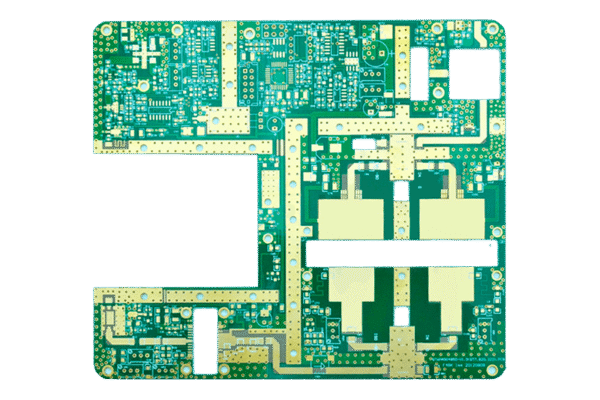
Integrating UWB into PCBs requires addressing high-frequency signal integrity, thermal management, and antenna design.
Signal Integrity and EMI Control
•High-Frequency Traces: UWB’s broad spectrum (up to 10.6 GHz) demands controlled impedance (typically 85Ω differential pairs) and low-loss substrates (e.g., Rogers materials) to minimize attenuation.
•EMI Shielding: Use grounded copper pours and shielded traces to isolate UWB transceivers from noise-sensitive components.
•Via Optimization: PCB vias can enhance antenna performance by mimicking electromagnetic mirroring effects, reducing size while maintaining bandwidth (e.g., 2.3–6 GHz microstrip antennas).
Antenna Integration
•Compact Designs: Fractal-based antennas on FR4 substrates achieve omnidirectional radiation with minimal space.
•Hybrid Antennas: Dual-mode antennas (e.g., UWB/Wi-Fi combos) reduce component count but require careful to avoid interference.
•Placement: Antennas should be to prevent detuning.
Power and Thermal Management
•Low-Power Layouts: Use dedicated voltage regulators and decoupling capacitors near UWB ICs (e.g., DW1000) to stabilize power.
•Thermal Vias: Dissipate heat from power amplifiers to prevent performance degradation.
Modularization for Rapid Deployment
•SiP Modules: System-in-Package solutions (e.g., Murata’s Type 2AB) reduce PCB area by 75% and simplify design.
•Pre-Certified Modules: Accelerate time-to-market by leveraging FCC/CE-certified UWB-BLE modules.
4. Industry Trends and Future Outlook

•Market Growth: The global UWB market is projected to reach $4.8–6.5 billion by 2030 (18–22% CAGR), driven by automotive and industrial applications.
•Standardization: FiRa Alliance and CCC are unifying protocols to ensure interoperability across devices.
•AI Integration: Next-gen chips (e.g., Qorvo’s QM35825) embed AI for enhanced signal processing and lower latency.
•Infrastructure Convergence: Wi-Fi 7 access points with built-in UWB radios will reduce deployment costs for enterprises.
5. How PCB Enterprises Can Adapt
•Invest in High-Frequency Expertise: Train teams on HFSS/CST simulations for impedance matching and antenna tuning.
•Collaborate with IC Suppliers: Partner with UWB chipmakers (e.g., Qorvo, NXP) to co-optimize layouts for specific SoCs.
•Focus on Miniaturization: Develop HDI PCBs with laser microvias to accommodate compact UWB modules.
•Embrace Standards: Adopt IPC-2141A for controlled impedance and PCI-SIG guidelines for high-speed designs.
Conclusion
UWB technology is redefining precision in wireless communication, offering unmatched accuracy for automotive, industrial, and consumer applications. For PCB enterprises, success hinges on mastering high-frequency design, antenna integration, and power efficiency. By embracing advanced materials, modular approaches, and industry collaborations, your business can position itself at the forefront of the UWB revolution—enabling smarter, safer, and more connected ecosystems.
Get your exclusive quote immediately: fill out the form or send an email directly.As a professional PCB manufacturer for hobbyist , we will provide you with a quote service within 24 hours. Enjoy free DFM optimization and a 10% discount on SMT patches for your first order!