

Conformal coating
Some electronic products must work in harsh environments such as salt spray, sand or dust, extreme temperatures and terrain. Therefore, maintaining the performance of electronic products is as important as the normal situation.
As the core of electronic products, PCB (printed circuit board) and PCBA (printed circuit board assembly) are responsible for implementing and facilitating functional implementation. If they can’t work in a harsh environment, the final product will be damaged or even fail.
In fact, there are some techniques that can prevent end-electronics from encountering problems in harsh environment from the start, that is in the process of PCB manufacturing or PCBA manufacturing. Shenzhen PCBA factory SysPCB will provide some tips to help boards and assembly boards work better in harsh environments, mainly in two ways: conformal coating and cleaning.
Principle and function of conformal coating
Conformal coatings are necessary for PCBs and PCBAs that must work in harsh environments. It protects the board from erosion, moisture, dust, etc., and ultimately extends the shelf life of the electronic product to ensure its performance and reliability.
It is a very important problem for electronic components and devices in manufacturing and application to maintain long-term stable performance in harsh environment. Therefore, necessary protective measures must be taken to ensure that electronic products work properly in harsh environments.
For harsh environments, the conformal coating should be optimized to better comply with extreme environments. Technical optimization should be carried out for the following items as protective measures: conformal coating shielding, static elimination and film thickness measurement.

Conformal coating shielding
Now, some parts of the PCB that do not require a conformal coating should be covered so that the conformal coating is not sprayed onto unnecessary parts (such as board holders, potentiometers, switches, power resistors, connectors). During the implementation of the conformal coating, the masking tape is usually used for the conformal coating shielding. In order to conform to the different shapes of the different components in the shield, the masking tape is cut into different shapes and sizes. This method tends to cause quality problems due to its disadvantages including low efficiency, static electricity generation, and excessive gel residue that are difficult to eliminate.
Optimization measures
Traditional masking tape should be replaced with 3M shielding tape. The cutting method should be used from the cutting of the tool to the application of a special cutting tool, since the latter can determine and cut different shapes depending on the shape, volume and size of the shielding cover. As long as the shield is covered with unnecessary parts, the conformal coating will not be sprayed on it.
What are the application areas of conformal coating?
In the industrial control industry, automotive electronics industry, aerospace industry, outdoor sports equipment industry, household electronics industry and other three anti-coatings because of its heat and humidity resistance, thermal shock resistance, corrosion resistance, aging resistance, flame resistance, insulation and Waterproof, rust-proof, salt spray and other properties can fully protect the circuit board.
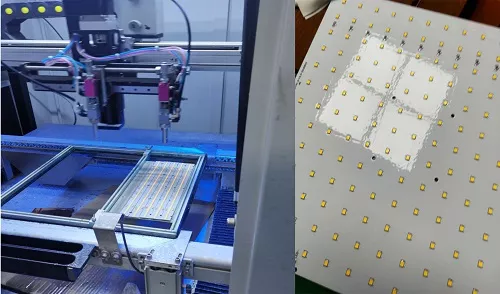
Classification of application fields of conformal coating:
1. Electronic industry circuit board protection
Three-proof coating can protect electronic equipment from water, moisture, external chemicals and special use environments to ensure its continuous stability, such as: LED display, LED guardrail tube, solar energy, instrumentation, Power supplies, frequency converters, consumer electronics, anti-theft, anti-alarm devices, switches, etc.
2. Aeronautical circuit board protection
Three-proof coating can protect electronic equipment from water, moisture, external chemicals and special use environments to ensure its continuous stability, such as: drone systems, flight control systems, fuel control systems, Simulation test system, anti-collision guidance system, security system, etc.
3. Automotive electronics industry
such as: gasoline vapor, salt spray, brake fluid, etc. The application of electronic systems in automobiles continues to grow rapidly, so the use of conformal coatings has become an essential requirement to ensure the long-term reliability of automotive electronic devices. Such as: computer control system, air conditioning, automotive electronics.
4. Commercial Household Circuit Board Protection
Conformal coatings provide protection for electronic circuits in household appliances, making them resistant to: such as: water, moisture, insects, harmful substances in offices and homes. Such as: soybean milk machine, coffee machine, induction cooker, dryer, dishwasher, air conditioner, computer, bathroom electronics, electric car, sweeper, etc.
The Impact of Poor Conformal Coating on PCBA
In the PCBA (Printed Circuit Board Assembly) process, conformal coating is an essential part. As the demand for higher quality PCBA products continues to rise, the requirements for conformal coating have become increasingly stringent. Therefore, selecting high-quality conformal coating is crucial. However, some poor-quality conformal coatings can have many negative effects on PCBA. In the following, we will detail the impacts of poor conformal coating on PCBA.
1. Decreased Conductivity
In PCBA production, poor conformal coating can lead to decreased conductivity of the PCBA. Specifically, such conformal coating may contain certain ions, such as sodium and potassium ions, which can interfere with the PCBA circuit, affecting the normal functioning of the circuit. Additionally, poor-quality conformal coatings may damage the metal traces on the PCBA, leading to circuit breaks or short circuits, which can affect the normal operation of the device.
2. Poor Corrosion Resistance
The primary function of conformal coating is to prevent damage to the PCBA due to moisture, corrosion, and similar factors. However, poor-quality conformal coatings have inferior corrosion resistance compared to high-quality coatings, meaning that the PCBA will be more susceptible to corrosion. If the PCBA becomes corroded, the metal traces may be damaged, affecting the normal operation of the device.

3. Impaired Heat Dissipation
PCBA manufacturers generate a significant amount of heat during operation, which needs to be dissipated. If heat is not dissipated in time, it can damage the circuit and even compromise device safety. High-quality conformal coatings have good thermal dissipation properties, which help the PCBA dissipate heat more effectively. However, poor-quality conformal coatings can negatively impact the heat dissipation of the PCBA, causing the circuit temperature to rise excessively, thus affecting the normal functioning of the device.
In conclusion, poor conformal coating can have many negative effects on PCBA, potentially affecting the normal operation of the device. Therefore, selecting high-quality conformal coating is crucial to ensure the quality and stability of PCBA.
What is the purpose of PCBA cleaning, and why do we need to conduct PCBA cleaning?
1. Appearance and electrical performance requirements

The most intuitional impact of contaminants on PCBA is the appearance of PCBA. If it is placed or used in a high temperature and humid environment, it may absorb moisture and the residue may turn white. Due to the widespread use of leadless chips, micro BGA, chip-scale packaging (CSP) and 0201 components in components, the distance between components and circuit boards is decreasing, the size of circuit boards is getting smaller and smaller, and the assembly density is increasing. In fact, if the halide is hidden under the component or cannot be cleaned at all, locally cleaning may lead to catastrophic consequences due to the release of the halide. This can also cause dendrites to grow, which can lead to short circuits. Improper cleaning of ionic contaminants can cause many problems: low surface resistance, corrosion, and conductive surface residues will form dendritic distributions (dendrites) on the surface of the circuit board, causing partial short circuits in the circuit.
The main threats to the reliability of military electronic equipment are tin whiskers and intermetallic compounds. This problem has always existed. Tin whiskers and intermetallic compounds will eventually cause short circuits. In a humid environment with electricity, if there is too much ion contamination on the components, it may cause problems. For example, due to the growth of electrolytic tin whiskers, the corrosion of the conductor, or the reduction of insulation resistance, the lines on the circuit board will be short-circuited.
Improper cleaning of non-ionic contaminants can also cause a series of problems. It may lead to poor adhesion of the circuit board soldermask, poor contact of the pins of the connector, poor resist of physical interference, and poor adhesion of the conformal coating to moving components and plugs. At the same time, non-ionic pollutants may also envelop the ionic pollutants in them, and may envelop and bring in other residues and other harmful substances. These are issues that cannot be ignored.
2. Conformal coating needs
To make the coating of the Conformal coating reliable, the surface cleanliness of the PCBA must meet the requirements of the IPC-A-610E-2010 level III standard. Resin residues that are not cleaned off before surface coating can cause delamination of the protective layer or cracks in the protective layer; activator residues may cause electrochemical migration under the coating, leading to the coating crack and failure of protection. Studies have shown that cleaning of PCBA can increase the coating adhesion rate by 50%.
3. Non-cleaning also needs to be cleaned
According to the current standard, the term “non-clean” means that the residue on the circuit board is chemically safe, will not have any effect on circuit board, and can be left on the circuit board. Corrosion testing, surface insulation resistance (SIR), electro-migration and other special testing methods are mainly used to determine the halogen/halide content, so as to determine the safety of non-clean solder paste after assembly. However, even using low solids ratio non-clean fluxes, there will still be more or less residues. For products with high reliability requirements, residues or other contaminants are not allowed to be on the circuit board. For military applications, even require cleaning of non-clean assembled PCBAs.
What is used to clean Circuit board during PCB process?
What is used to clean Circuit board during PCB processing? We can use water to wash the PCB. water is aimed to clean the PCB surface after welding residual flux and rosin with industial detergent liquid chemical. There are other methods of cause, water washing is the main method of PCB cleaning, normally after washing, PCB need to be baked if it is in the final processes. There are three type of washing water with solvent.
1. Chlorinated solvent wash water:
Is a mixture of chlorinated solvents and other; Rosin and its dissolving purify flux speed, no residual volatile after cleaning without drying characteristics. Such as abundant industrial environmental protection water wash plate FRB – 1.1.
2. Hydrocarbon solvent washing plate water:
With the widely use of hydrocarbon cleaning agent, solvent is also used in PCB cleaning; Water has quick drying solvent washing plate type and slow dry type; Quick dry type generally good cleaning effect and solvent washing plate water environmental protection, non-toxic, low odor, distillation recycling use, the more used in high precision PCB cleaning, such as hydrocarbon solvent washing plate water FRB – 143.
3. Water-based type plate washing water:
For water-based cleaning agent with environmental protection, security, non-toxic, without excitant gas volatilization characteristics, the author also found out of the water base class market recently wash water, but because of the circuit board pin has a metal component, if water-based type plate washing water should be careful, don’t have antirust function for water-based cleaning agent to speed up the pin corrosion rust.
Conformal coating Other Method of application:
1. Artificial brush method:
there will be needed again to clean circuit board with some solvent wool brush wash boards with rosin and accelerate the dissolve of rosin flux and the flux of the loss.
2. Ultrasonic cleaning:
place the circuit board in the jig to prevent damage caused by ultrasonic vibration to electronic components, in the ultrasonic cleaning tank, we need to determine a ultrasonic frequency and cleaning time.