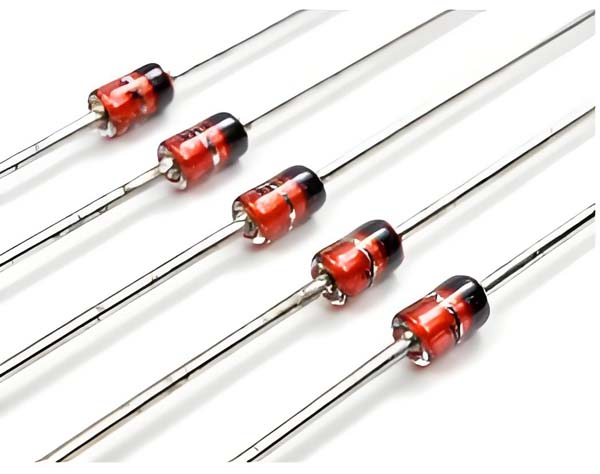
In the overvoltage protection module of smartphone chargers, in the precision voltage reference source of satellite communication equipment, and even in the battery management system(BMS) of electric vehicles, the voltage regulator diode (Zener diode) serves as the “voltage gatekeeper” of electronic circuits. With its unique reverse breakdown characteristics, it has become an indispensable protection core in PCB design. Its value lies not only in stabilizing voltage, but also in eliminating fatal threats such as surges and spikes with millisecond level response.
Table of Contents
1、 Core principle: Voltage stabilization art in reverse breakdown
The working cornerstone of a voltage regulator diode is composed of the Zener diode effect and avalanche effect
-Reverse bias characteristic: When the reverse voltage reaches the breakdown threshold (Vz), the current increases sharply while the voltage remains constant, forming a stable voltage platform.
-Dynamic resistance as low as Ω level: The dynamic resistance (Rz) of high-quality voltage regulators can be lower than 5 Ω, ensuring that the output voltage fluctuation is ≤ 1% when the load fluctuates.
-Temperature compensation technology: The high-voltage type (>5V) has a positive temperature coefficient (+2mV/℃), while the low-voltage type (<5V) has a negative coefficient (-3mV/℃). Precision circuits often use series complementary transistors to achieve ultra-low drift of ± 0.02%/℃.
Accurate control of breakdown voltage:
By adjusting the PN junction thickness through semiconductor doping process, the voltage stabilization value can cover the range of 2.4V~200V. For example, the 5.1V voltage regulator has become the gold standard for universal design due to its temperature coefficient approaching zero.
2、 Three core application scenarios in PCB design
1. Overvoltage protection: the “fuse” of the circuit

-Power inlet protection: Zener Diode parallel connected to the DC/DC input terminal. When the voltage exceeds 36V due to lightning surge or switch noise, the transient response is ≤ 10ns, and the voltage is clamped at a safe value.
-Typical case: In the TV power board, a 12V voltage regulator is connected in series with a voltage divider resistor to monitor the main power supply. When the voltage rises abnormally to 15V, the protection circuit is triggered to shut down to prevent the main IC from burning out.
2. Precision voltage reference: the “anchor” of analog circuits
-ADC reference source design: using temperature compensated voltage regulator (such as LM399), providing a reference accuracy of ± 0.01% in the temperature range of -40 ℃~85 ℃, far superior to ordinary LDO.
-Signal conditioning circuit: At the front end of the sensor, a 6.2V voltage regulator provides stable bias for the operational amplifier, ensuring that the thermocouple microvolt level signal amplification is not affected by power fluctuations.
3. Surge absorption and arc suppression
-Relay/motor drive protection: Reverse connect voltage regulators at both ends of inductive loads (such as car relay coils). When the MOSFET is turned off, the 200V reverse electromotive force generated by the coil is clamped to 24V to protect the switch tube from breakdown.
-Communication line protection: The A/B lines of the RS485 interface are connected to ground with 18V voltage regulators, effectively resisting EFT group pulse interference.
3、 Layout and Wiring: The Golden Rule of High Reliability Design
1. Thermal management design
-Power density calculation: For voltage regulators above 1W (such as BZX85 series), the following requirements must be met:
Copper foil area ≥ (3 × P) cm ² (P is power consumption, unit: W)
For example, a 1.5W voltage regulator on a 2oz copper foil requires a heat dissipation area of ≥ 4.5cm ².
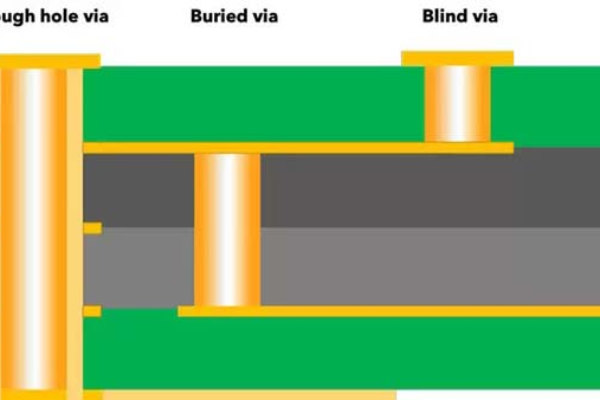
-Thermal path optimization: A thermal via array is used to connect the top solder pad to the internal ground plane, with a via spacing of ≤ 1.5mm, reducing thermal resistance by 40%.
2. High voltage isolation and EMC design
-Creepage distance: In a 220VAC input circuit, the distance between the voltage regulator and the high-voltage wiring should be ≥ 3.5mm (in accordance with IEC 60950 standard).
-Noise suppression:
-Parallel 10nF ceramic capacitors are connected at both ends of the digital circuit voltage regulator to absorb high-frequency switching noise
-The sensitive analog circuit adopts a π – type filter:
| input → magnetic beads → voltage regulator → 0.1 μ F capacitor. |
3. Failure prevention strategies
-Current limiting resistor calculation: The resistance value must meet the following requirements:
| R ≥ (V<sub>in_max</sub> – Vz) / I<sub>z_min</sub> R ≤ (V<sub>in_min</sub> – Vz) / (I<sub>z_max</sub> + I<sub>load</sub>) |
For example, when inputting 12V ± 10%, with a load of 50mA, and using a 5.1V/500mW voltage regulator, R is set to 100 Ω± 5%.
-Double protection mechanism: In high-power scenarios, the voltage regulator and TVS transistor are used in series. TVS tubes absorb nanosecond level surges, while voltage regulators handle millisecond level overvoltages, forming a dual protection network.
4、Industry Trends of Zener Diodes: New Materials and Intelligence Drive Change
1. Wide bandgap semiconductor revolution
-SiC/GaN voltage regulator: breakdown voltage exceeds 3kV, operating temperature reaches 200 ℃, increasing the power density of electric vehicle OBC (on-board charger) by three times.
-CSP package: 01005 size (0.4 × 0.2mm) voltage regulator supports 60GHz millimeter wave circuit board level integration.
2. Intelligent diagnostic integration
-Built in sensors: The new generation voltage regulator integrates temperature/current monitoring, reports overvoltage events and life prediction through the I ² C interface, and has a fault warning accuracy rate of over 95%.
3. Market growth engine
The global market size is expected to reach $225 million in 2023 and $348 million in 2030 (CAGR 6.33%), driven by:
-New energy vehicle electronic control system (with a usage of ≥ 15 pieces per vehicle)
-5G base station power supply (single station voltage regulator tube ≥ 8 pieces)
-Industrial IoT sensors (annual demand growth rate of 12%).
5、 Selection Design Guide: Avoiding 90% of Design Pitfalls
| Parameters | Consumer Electronics | Industrial Equipment | Automotive Electronics |
| Voltage regulation value (Vz) | 3.3V/5.1V | 12V/24V | 5V/12V (AEC-Q certified) |
| Accuracy | ± 5% | ± 2% | ± 1% |
| Power consumption | 200mW | 1W~5W | 1.5W (with heat dissipation pad) |
| Dynamic resistance | 20 Ω | ≤ 10 Ω | ≤ 5 Ω |
Fatal Error Avoidance:
-Misconception 1: Failure to consider temperature coefficient leads to low temperature startup failure → Choose a compensation model for the full temperature range of -40 ℃~125 ℃
-Misconception 2: Excessive leakage current (Ir) leads to a sudden increase in standby power consumption → Optimal selection of low leakage tubes with Ir<1 μ A (such as BZT52 series)
-Misconception 3: Failure to reserve a reflow soldering thermal stress zone → The distance between the edge of the solder pad and the device body is ≥ 0.3mm.
When autonomous driving systems accurately identify obstacles in heavy rain, and when spacecraft maintain long-term service in deep space environments for 10 years – behind these technological miracles are countless voltage defense lines built on PCBs with nanoscale material control and microsecond level response speed.
It is predicted that the global market size of voltage regulators will exceed 348 million US dollars by 2030. For electronic manufacturing enterprises, mastering the application design of voltage regulator diodes not only means improving the reliability of circuit boards, but also winning the technical pass to the high-end market in the wave of new energy and AIoT. The voltage regulator on each copper-clad board is the lifeline of electronic systems in extreme environments – this is the ultimate value of precision manufacturing.