Table of Contents
Introduction to Wi-SUN
Wi-SUN (Wireless Smart Utility Network) is an open standard protocol based on IEEE 802.15.4g that enables secure, reliable, and scalable wireless communication for large-scale Internet of Things (IoT) applications . As a leading Sub-1 GHz mesh networking solution, Wi-SUN has gained significant traction in smart grid, smart city, and industrial IoT applications, with over 100 million deployed devices worldwide, making it the largest outdoor IoT network .
For PCB manufacturers and designers, understanding Wi-SUN technology is crucial as it presents unique design challenges and opportunities in RF circuit design, power management, and thermal performance. This article explores the technical specifications, applications, and PCB design considerations for implementing Wi-SUN solutions.
1.Technical Specifications and Protocol Architecture
Physical Layer Characteristics
Wireless Smart Utility Network operates primarily in Sub-1 GHz frequency bands, which offer superior propagation characteristics compared to 2.4 GHz solutions, providing longer range and better obstacle penetration . The specific frequency bands vary by region:
•North America: 902-928 MHz
•Europe: 863-876 MHz
•Japan: 920-928 MHz
The technology supports multiple data rates ranging from 50 kbps to 2.4 Mbps, with the latest Wi-SUN FAN 1.1 specification supporting rates up to 2.4 Mbps through OFDM modulation . This flexibility in data rates allows designers to optimize between range, data throughput, and power consumption based on application requirements.
Network Architecture and Profiles
Wi-SUN supports various network configurations through standardized profiles:
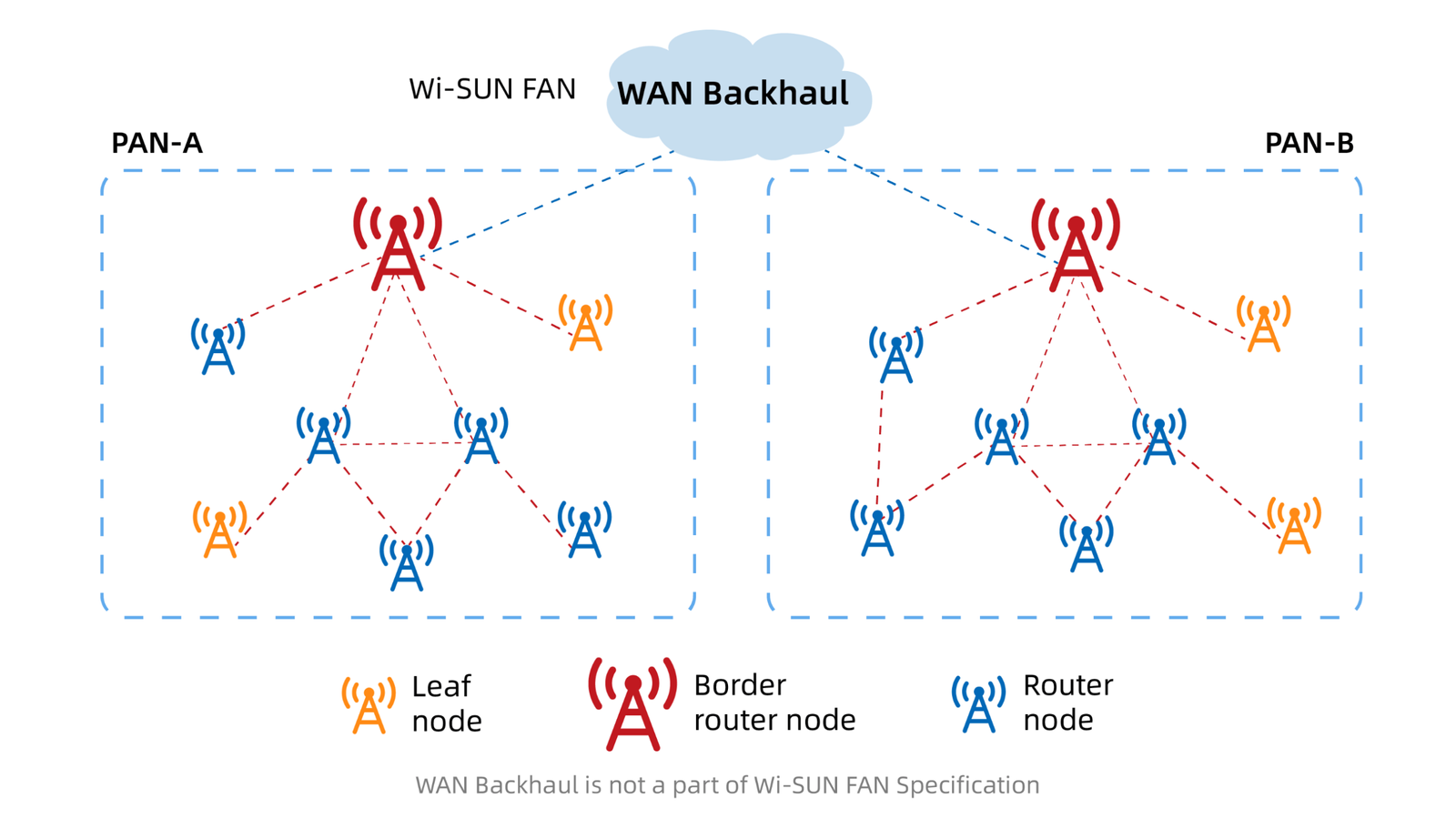
•FAN (Field Area Network): Designed for large-scale outdoor networks covering wide areas, supporting mesh networking with self-forming and self-healing capabilities
•HAN (Home Area Network): Focused on in-home energy management and smart appliance connectivity
•JUTA: Profile optimized for telemetry applications in smart gas and water meters with ultra-low power requirements

2.Key Features and Advantages of Wi-SUN
Robust Mesh Networking
Wi-SUN utilizes a self-healing mesh network topology that creates robust, reliable wide-area networks less susceptible to interference than other network topologies . This mesh architecture enables:
•Automatic network reconfiguration when nodes fail or new nodes join
•Multiple communication paths for enhanced reliability
•Extended coverage through multi-hop communication
•Scalability to support thousands of nodes in a single network
Interoperability and Open Standards
As an open standard protocol managed by the Wi-SUN Alliance with over 300 member companies, Wi-SUN ensures multi-vendor interoperability . This open approach:
•Prevents vendor lock-in
•Encourages ecosystem development
•Reduces deployment risks through certified interoperability programs
Security Features
Wi-SUN incorporates enterprise-class security through certificate-based mutual authentication, message encryption, integrity checking, and key rotation following best practices from NIST, IEEE, and IETF . Additional security measures can include hardware-based protection with PSA Level 3 Certified Secure Vault technology .
3.PCB Design Considerations for Wi-SUN Applications
RF Circuit Design
Designing PCBs for Wireless Smart Utility Network applications requires careful attention to RF circuit implementation:
•Impedance Matching: Ensure proper impedance matching (typically 50Ω) between the RF IC, transmission line, and antenna to maximize power transfer and minimize reflections
•Ground Planes: Implement continuous ground planes beneath RF components to provide low-impedance return paths and minimize noise
•Component Placement: Position matching networks and passive components close to the RF IC to minimize parasitic effects and trace losses
•Shielding: Use RF shields for sensitive circuits to prevent interference and emissions
Power Management
Wi-SUN devices often operate in demanding environments with strict power requirements:
•Power Supply Decoupling: Implement proper decoupling capacitors near power pins to suppress noise and ensure stable operation
•Power Segmentation: Separate analog, digital, and RF power domains to prevent noise coupling
•Low-Power Design: For battery-operated devices requiring up to 10 years of service life , implement power-saving techniques such as sleep modes and efficient power regulation
Thermal Management
High-power applications such as utility-grade communication devices require careful thermal design:
•Thermal Vias: Use thermal via arrays under high-power components to dissipate heat to inner layers or opposite side of the board
•Copper Pouring: Incorporate large copper areas connected to component pads to enhance heat dissipation
•Component Spacing: Ensure adequate spacing between heat-generating components to prevent hot spots
4.Applications in Smart Utilities and Cities
Smart Grid and Advanced Metering Infrastructure
Wi-SUN is widely deployed in smart metering applications, with Japan alone planning to incorporate the technology in up to 66 million electric meters . Key benefits include:
•Bidirectional communication for real-time monitoring and control
•Long-range connectivity covering diverse terrain from dense urban to rural areas
•High node count support for utility-scale deployments
Smart Street Lighting
Wireless Smart Utility Network enables intelligent street lighting systems with:
•Centralized control and monitoring
•Energy optimization through adaptive dimming
•Fault detection and maintenance alerts
•Integration with other city sensors
Emerging IoT Applications
Beyond traditional utility applications, Wi-SUN is expanding into:
•Environmental monitoring
•Asset tracking and management
•Industrial automation
•Agricultural sensors
•Electric vehicle charging infrastructure
5.Latest Developments: Wi-SUN FAN 1.1
The recently introduced Wireless Smart Utility Network FAN 1.1 specification offers significant enhancements:
•Higher data rates up to 2.4 Mbps using OFDM modulation
•Improved power efficiency for battery-operated devices
•Enhanced network reformation capabilities for faster recovery from network outages
•Backward compatibility with FAN 1.0 devices
These improvements make FAN 1.1 particularly suitable for applications requiring higher bandwidth, such as firmware updates over the air (FOTA) and data-intensive sensor applications .
6.Implementation and Certification
Development Resources
Companies developing Wireless Smart Utility Network products can leverage:
•Certified stacks from solution providers
•Development kits for rapid prototyping
•Reference designs with optimized PCB layouts
•Interoperability testing facilities
Certification Process
The Wireless Smart Utility Network Alliance operates a rigorous certification program that ensures devices correctly operate in multi-vendor networks . Certification involves:
•Protocol conformance testing
•Interoperability testing
•Security validation
•Performance verification
Conclusion: Positioning for the Wi-SUN Opportunity
Wi-SUN technology represents a significant opportunity for PCB manufacturers and designers as adoption grows across utility, municipal, and industrial sectors. The technology’s robust mesh networking, proven scalability, and strong security features make it ideal for critical infrastructure applications.
For PCB companies, developing expertise in Wireless Smart Utility Network implementation provides a competitive advantage in several ways:
•Technical Differentiation: Mastering RF design for Sub-1 GHz mesh networks establishes your capability in demanding IoT applications
•Value-Added Services: Offering reference designs and design guidelines for Wi-SUN applications creates new service opportunities
•Market Expansion: Enabling entry into growing markets like smart utilities, cities, and industrial IoT
As Wireless Smart Utility Network continues to evolve with enhancements like FAN 1.1 and gains broader industry adoption through efforts of companies like TI, Silicon Labs, and Digi International , the technology is poised to become even more prevalent in large-scale IoT deployments.
By understanding the technical requirements, design considerations, and application opportunities presented by Wi-SUN, PCB companies can position themselves as valuable partners in the rapidly expanding ecosystem of connected devices and infrastructure.