Counterbore and Countersink Hole in PCBs are two special hole types used in PCB design for installing fasteners (such as screws). Their core function is to ensure that the fastener head is flush with the PCB surface, avoiding affecting the installation of other components or the flatness of the appearance. Here is a detailed analysis of both:
Table of Contents
Ⅰ.Definition and structural differences
1. Countersun Hole
A countersunk hole usually refers to a conical hole, with a conical inclined surface at its entrance (commonly at an angle of 90 ° or 120 °), used to accommodate the conical head of a countersunk screw, allowing the screw to fully sink into the hole, with the surface flush with the PCB. For example, the conical countersunk hole of Jialichuang needs to match the angle and depth according to the screw size to ensure that it does not protrude after installation.
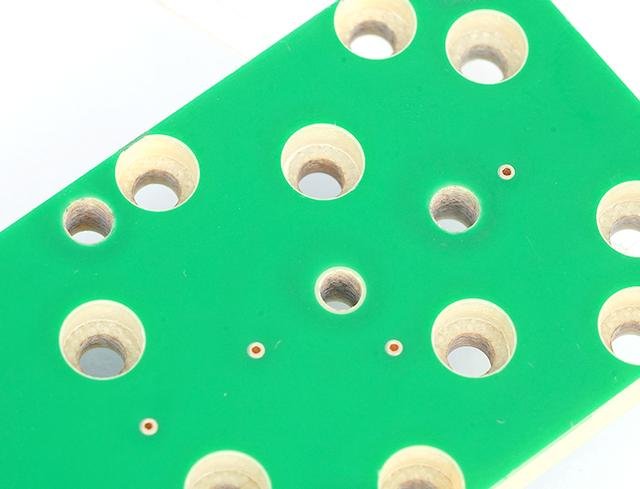
-Processing method: First drill a through hole, then use a conical drill bit to enlarge the hole, forming a stepped structure.
-Application scenario: Scenes that require a flat surface, such as areas where the shell is fixed and where interference from components needs to be avoided.
2. Counterbore Hole
A countersunk hole usually refers to a cylindrical hole with a cylindrical groove at the entrance, used to accommodate the head of a flat head screw or bolt, allowing the head to sink into the hole but maintain a vertical structure. For example, the JIS standard stipulates that the cone angle of the countersunk hole should be 90 °± 1 °, which should match the size of the countersunk screw.
-Processing method: Use a step drill or countersunk drill to process step by step, forming a stepped aperture.
-Application scenario: Connections that require significant mechanical stress, such as interlayer fixation of multi-layer boards or installation of structural components.
Ⅱ.Design key elements
1. Size matching
-Countersunk hole: The diameter of the conical part should be larger than the diameter of the screw head (usually 0.2-0.5mm larger), and the depth should be slightly greater than the height of the screw head. For example, M3 screws correspond to countersunk holes with a diameter of approximately 5.8-6.0mm and a depth of approximately 2mm.
-Counterhead hole: The diameter of the cylindrical groove should be consistent with the diameter of the screw head, and the depth should accommodate the head with a reserved margin of 0.2-0.3mm. For example, M4 screws correspond to countersunk holes with a diameter of approximately 8mm and a depth of approximately 7mm.
2. Position accuracy
-The positional error between the countersunk hole and the countersunk hole should be controlled within ± 0.1mm to avoid conflicts with solder pads, circuits, or other hole positions. For example, Jialichuang requires a minimum gap of 0.2mm between the countersunk hole and the surrounding copper surface.
3. Depth control
-The depth of the countersunk hole should be designed in conjunction with the plate thickness, and the total plate thickness minus the depth of the countersunk hole should be greater than 0.2mm to prevent structural failure caused by drilling through. For example, when the plate thickness is 1.6mm, the depth of the sinkhole should not exceed 1.4mm.
Ⅲ.Manufacturing process and precautions
1. Processing flow
-Countersunk hole: drilling → conical hole enlargement → deburring → cleaning. For example, the drilling speed of FR-4 material needs to be controlled at 80-120m/min, and a hard alloy milling cutter should be used for hole expansion.
-Countersunk hole: drilling → step drilling → countersunking → deburring. For example, a step drill can complete drilling and expanding holes in one go, improving efficiency.
2. Quality control
-The hole wall should be smooth and free of burrs to avoid damaging screws or affecting electrical performance. The multi-layer board needs to ensure the integrity of the hole wall coating to prevent damage to the inner layer circuit.
-Use coordinate measuring instruments to detect aperture, depth, and positional accuracy to ensure compliance with design requirements.
3. Design software support
-Altium Designer: To achieve countersunk hole design through custom pad or mechanical layer annotations, it is necessary to set the aperture, copper plating properties, and avoidance rules.
-Jialichuang EDA: Supports 3D shell design, can directly generate countersunk hole parameters and place orders for manufacturing.
Ⅳ.Terminology Analysis and Industry Standards
1. Mixing names
-Countersunk holes and countersunk holes are mixed in some scenarios, but strictly speaking, countersunk holes refer specifically to conical structures, while countersunk holes can refer to cylindrical or conical structures. For example, the CSDN blog points out that the difference between the two lies in their structure (straight tube vs conical), but in practical applications, they are often considered synonymous.

2. Industry standards
-JIS standard: The taper angle of the countersunk hole is specified as 90 °± 1 °, and the matching relationship between the size and the screw is clarified.
-IPC standard: It is recommended that the distance between the edge of the countersunk hole and the solder pad be ≥ 0.2mm to ensure machining safety.
Ⅴ.Typical application cases
-Consumer electronics: The fixing holes on the outer shell of the mobile phone motherboard use countersunk holes to ensure a smooth surface after assembly and avoid scratching the user.
-Industrial equipment: The interlayer fixation of multi-layer PCBs uses countersunk holes to withstand high mechanical stress and ensure signal transmission stability.
-Medical instruments: The installation holes of high-precision equipment use countersunk holes to reduce surface protrusions and meet cleanliness requirements.
Summarize
The core difference between countersunk holes and countersunk holes lies in their structure (conical vs cylindrical), but both serve the flat installation requirements of fasteners. When designing, it is necessary to select the appropriate hole type according to the screw type, plate thickness, and process requirements, and strictly control the size, position, and processing quality. Through reasonable design, countersunk holes and countersunk holes can significantly improve the mechanical stability and appearance quality of PCBs.
Get your exclusive quote immediately: fill out the form or send an email directly.As a professional PCB manufacturer for hobbyist , we will provide you with a quote service within 24 hours. Enjoy free DFM optimization and a 10% discount on SMT patches for your first order!