Introduction
In the world of DC motors, the choice between brushed and brushless (BLDC) technologies significantly impacts performance, efficiency, and design complexity. For PCB enterprises, understanding these differences is crucial, as motor controllers—whether for brushed or brushless systems—rely heavily on advanced printed circuit boards to deliver precision, reliability, and integration. This article explores the fundamental distinctions between brushed and brushless motors, their applications, and the critical PCB design considerations for developing robust motor control systems.
Table of Contents
1. Brushed DC Motors: Basics and PCB Integration
Brushed DC motors operate via mechanical commutation, where carbon brushes and a physical commutator switch current direction in the rotor windings to generate motion.
Key Characteristics:
•Simple Control: Brushed motors require basic PCB-based circuits (e.g., H-bridges with MOSFETs) for speed and direction control.
•Maintenance Needs: Brushes wear out over time, necessitating replacements and limiting lifespan to hundreds or thousands of hours.
•Noise and EMI: Brush-commutator contact generates sparks, acoustic noise, and electromagnetic interference (EMI), demanding robust PCB shielding and filtering.
PCB Design Challenges:
•EMI Mitigation: Shielding techniques (e.g., grounded copper pours) and filters are essential to suppress noise.
•Thermal Management: Brushed motors exhibit lower efficiency (typically 70–80%), leading to heat buildup. PCBs must integrate thermal vias and heatsinks.
•Cost-Efficiency: Simple control circuits make brushed systems ideal for cost-sensitive applications like toys and small appliances.
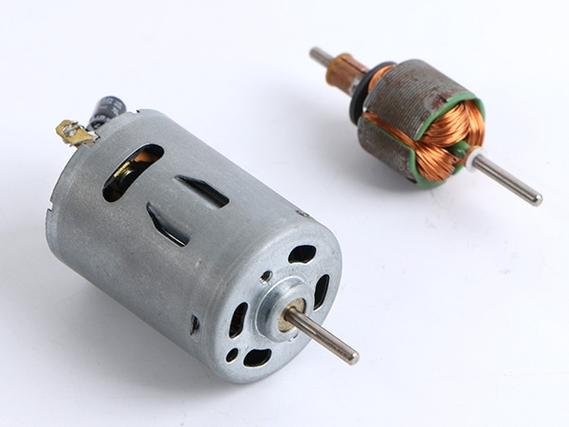
2. Brushless DC Motors (BLDC): Advanced Control and PCB Complexity
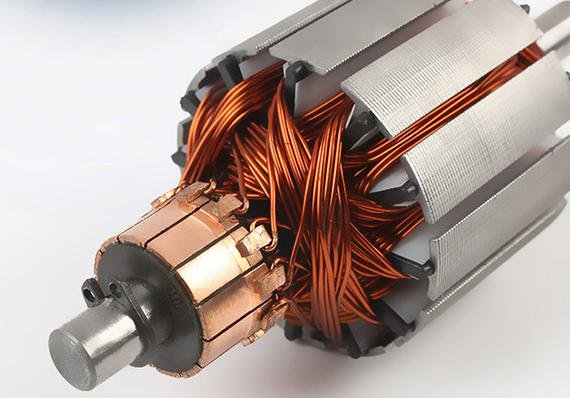
BLDC motors replace mechanical commutation with electronic control. Hall effect sensors or sensorless algorithms detect rotor position, and a PCB-based controller dynamically switches currents in the stator windings.
Key Advantages:
•High Efficiency: BLDC motors achieve 85–95% efficiency due to reduced friction and precise current control.
•Longevity: Without brushes, lifespan extends to tens of thousands of hours.
•Low Noise and EMI: Electronic commutation minimizes sparks and acoustic noise, critical for consumer and medical applications.
PCB Design Challenges:
•Complex Control Circuits: BLDC controllers require microcontrollers (MCUs), gate drivers, and MOSFET arrays for precise phase switching.
•Signal Integrity: High-frequency switching (e.g., PWM signals) demands careful impedance control and low-loss substrates to prevent noise.
•Thermal Management: Power components (e.g., MOSFETs) generate heat; PCBs must use thermal vias, copper cores, and heatsinks.
•Sensor Integration: Hall sensors or encoder interfaces require noise-isolated traces and precise layout planning.
3. Comparative Analysis: Brushed vs. Brushless Motors
| Parameter | Brushed Motors | Brushless Motors (BLDC) |
| Efficiency | 70–80% | 85–95%+ |
| Lifespan | Hundreds to thousands of hours (brush wear) | Tens of thousands of hours (bearing-dependent) |
| Control Complexity | Simple (voltage/PWM control) | Complex (MCU-driven FOC/sinusoidal control) |
| EMI/Noise | High (sparks and friction) | Low (electronic commutation) |
| Cost | Lower motor cost, simpler PCB | Higher system cost (controller-intensive) |
| Ideal Applications | Toys, small appliances, cost-sensitive systems | EVs, drones, industrial automation, medical devices |
4. PCB Design Considerations for Motor Control Systems
4.1 Power Delivery and Layout
•High-Current Traces: Use thick copper layers (e.g., 2–4 oz) for motor power paths to reduce resistance and heating.
•Component Placement: Group power components (MOSFETs, drivers) near connectors to minimize loop inductance and EMI.
4.2 Thermal Management
•Heatsinking: Integrate thermal pads and vias under power ICs; use metal-core PCBs for high-power designs.
•Dissipation: Brushed systems prioritize rotor heat dissipation; BLDC designs focus on stator and PCB heat management.
4.3 Signal Integrity and Noise Control
•Shielding: Enclose noise-sensitive circuits (e.g., sensors) with grounded guards.
•Filtering: Add LC filters on PWM lines to suppress high-frequency noise.
4.4 Advanced Techniques
•Embedded Components: For space-constrained BLDC designs, embed passive components (resistors/capacitors) within PCB layers.
•High-Frequency Materials: For BLDC controllers exceeding 100 kHz, use low-loss dielectrics (e.g., Rogers substrates) to maintain signal integrity.
5. Industry Applications and Trends
•Automotive: BLDC motors dominate EVs (traction drives, pumps) due to efficiency and longevity; brushed motors remain in cost-effective modules (e.g., window lifts).
•Industrial Automation: BLDC-based servo drives enable precise motion control in robotics and CNC machines.
•Consumer Electronics: Drones and HVAC systems use BLDC motors for quiet operation; brushed motors persist in low-cost toys.
•Medical Devices: BLDC motors power infusion pumps and surgical tools where reliability and low noise are critical.
6. Future Outlook and PCB Opportunities
•Integration: PCB-based motor controllers will increasingly merge with IoT connectivity (e.g., CAN bus, Bluetooth for diagnostics).
•Miniaturization: HDI PCBs with microvias enable compact BLDC controllers for wearable devices and micro-robotics.
•Sustainability: Higher efficiency standards (e.g., EU Ecodesign) will drive BLDC adoption, expanding opportunities for advanced PCB solutions.
Conclusion
The choice between brushed and brushless motors hinges on application-specific needs: brushed motors offer simplicity and low cost, while BLDC systems deliver superior efficiency, control, and longevity. For PCB enterprises, mastering design techniques for both technologies—from EMI suppression and thermal management to high-frequency signal integrity—is key to capturing opportunities in automotive, industrial, and consumer markets. By leveraging advanced materials and layout strategies, your business can develop next-generation motor controllers that redefine performance and reliability.
Get your exclusive quote immediately: fill out the form or send an email directly.As a professional PCB manufacturer for hobbyist , we will provide you with a quote service within 24 hours. Enjoy free DFM optimization and a 10% discount on SMT patches for your first order!