Table of Contents
What is a traditional solderless PCB breadboard?
The traditional solderless PCB breadboard is a core tool for electronic engineers, students, and enthusiasts in the early stages of circuit design. It connects component pins through internal metal spring plates, allowing for quick prototyping of circuits without the need for soldering. Due to its reusability and low cost, it has become an “experimental sandbox” for verifying circuit logic and debugging functions.
As a professional PCB manufacturing enterprise, we deeply understand that from breadboards to customized PCBs, it is a necessary path for electronic design from prototype to mass production.
Core structure and advantages of solderless PCB breadboard
1. Modular design
-The breadboard consists of multiple 5-hole “node rows” and power rails on both sides, supporting fast insertion of integrated circuits (ICs), resistors, capacitors, and other components.
-Tip: Distinguishing power rails by color (red+, blue -) can reduce wiring errors.
2. No need for welding, plug and play
-Skip the welding step and connect the circuit directly through jumper wires, suitable for fast iterative design.
-Students and beginners can intuitively understand circuit principles, reducing the learning threshold.
3. Low cost feasibility verification
-Before entering PCB production, verify the functional logic with breadboards to avoid design defects that may result in batch losses.
Typical application scenarios of solderless PCB breadboards
-Education and training: electronic course experiments, maker workshops
-Product development: Sensor testing, single-chip control circuit debugging
-Maker project: Smart home prototype, robot control module
Circuit boards that require soldering (similar to breadboard layout)
-Possible correct terms to refer to:
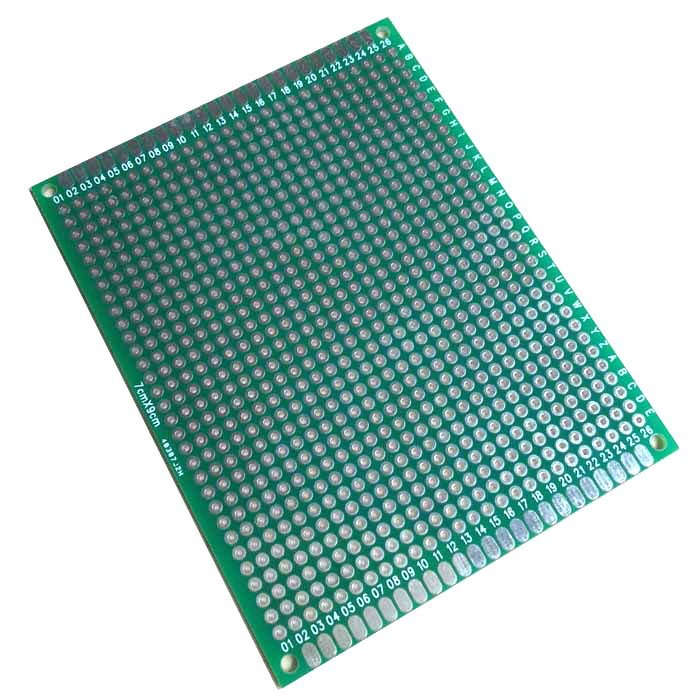
-Perfboard: with regularly arranged holes and copper pads, requiring manual soldering of connections.
-Stripboard: There are pre connected copper bars between the holes, which can be cut and welded as needed.
-Protoboard: A PCB layout similar to a breadboard (such as power rails, segmented connections), but requires soldering.
-Purpose: More stable prototype design, serving as a transition between breadboards and custom PCBs.
How to efficiently transition from PCB breadboard to custom PCB?
Although breadboards are suitable for early validation, their limitations are also evident:
-Poor stability: Loose insertion may lead to poor contact
-Low complexity: difficult to support high-frequency signals or complex multi-layer circuits
-Volume limitation: unable to meet the demand for product miniaturization

At this point, customized PCB will become the best choice:
1. Precise design: Convert breadboard circuits into PCB layouts using EDA software such as Altium and KiCad
2. Stable mass production: Customized PCB provides high reliability connections, suitable for long-term use
3. Cost optimization: During mass production, the unit price of PCB is much lower than that of manual assembly
3 Practical Tips for Using Weldless Bread Boards
1. Planning wiring logic: Use different colored jumpers to distinguish power, signal, and grounding wires, avoiding confusion
2. Modular partitioning: Separate the layout of power management, control units, and sensors for easy debugging
3. Record the experimental process: take photos or draw circuit diagrams to provide reference for subsequent PCB design
Conclusion: From experiments to products, we provide full support throughout the process
Solder free PCB breadboards are the starting point of electronic innovation, while customized PCBs are the key to achieving productization. As a professional PCB manufacturer, we offer:
-Quick sampling service: 24-hour fast shipping, supporting double-sided board, aluminum substrate and other processes
-Low cost mass production solution: flexible pricing strategy, adapted to meet the needs of startups to large manufacturers
-Technical support: DFM inspection, impedance calculation and other value-added services to ensure a successful design in one go
Contact us immediately to accelerate the conversion of your PCB breadboard ideas into mass-produced PCB products!