>When shrimp farmer Nguyen remotely adjusts the salinity of the shrimp pond through his phone, he no longer has to worry about drought destroying a year’s harvest – behind this is the disruptive change of the Internet of Things to traditional agriculture
Global agriculture is facing triple pressures of population growth, climate change, and resource scarcity. The Food and Agriculture Organization of the United Nations predicts that global food production will need to increase by 70% by 2050 to meet demand. The Internet of Things (IoT) technology is building a smart agriculture closed-loop of “perception decision execution” through sensor networks, data analysis, and automated control, providing key technical support for this food security campaign.
Table of Contents
1、 How the Internet of Things can reconstruct the entire agricultural production chain
1. Environmental perception and precise control system
-Soil and Meteorological Monitoring
Deploy NB IoT/LoRa sensor network to collect real-time soil moisture, temperature, pH value, light intensity, and meteorological data, and transmit them to the cloud platform for analysis. After applying this system in the rice fields of Yixing, Jiangsu, the yield per mu increased by 5% and the nitrogen fertilizer usage decreased by 5%.
-Intelligent greenhouse control
Shandong Shouguang Intelligent Greenhouse automatically adjusts environmental parameters based on sensor data through IoT linkage of rolling shutter machines, ventilation systems, wet curtain water pumps and other equipment. Compared to traditional greenhouses, energy consumption is reduced by 35% and fruit and vegetable yields are increased by 15% -20%.
2. Resource optimization and automated management
| Application scenarios | Technical solutions | Benefits |
| Intelligent irrigation | Soil moisture sensor+solenoid valve linkage | Water saving by 40%, energy cost reduced by 25% |
| Precision fertilization | Spectral analysis of crop fertilizer requirements+variable fertilizer applicator | Reduce fertilizer usage by 30%, increase yield by 8% |
| Livestock Health Management | Neck Ring Sensor Monitoring Body Temperature/Activity | Disease Warning 72 Hours in Advance |
3. Risk warning and disaster prevention and control
-Aquaculture: Ultrasonic sensors monitor water level, PT100 temperature sensors warn of abnormal water temperature, and linked oxygenation equipment prevents fish schools from lacking oxygen.
-Disease and pest control: AI image recognition of leaf lesions, combined with meteorological data to predict the probability of outbreak, precise pesticide application reduces chemical dosage by 50%.
2、 How core technologies drive the implementation of agricultural IoT
1. Perception layer: Multi dimensional data collection
-Soil moisture monitoring: capacitive sensor measures volumetric moisture content (accuracy ± 3%)
-Livestock biosensing: RFID ear tags collect heart rate and rumination data (applied in Dutch pig farms to reduce mortality by 15%)
-Water quality analysis: dissolved oxygen/ammonia nitrogen sensor warning for aquaculture risks
2. Transport layer: Low power wide area network
– LoRaWAN ® Technology: The Star Vertical Intelligent Solution achieves ultra long coverage of 10km, with a battery life of 5 years, suitable for remote farms.
-NB IoT network: Huawei collaborates with Yunyang Data to deploy sensor nodes directly to the cloud in 36 million greenhouses.
3. Application layer: AI decision-making and automatic control
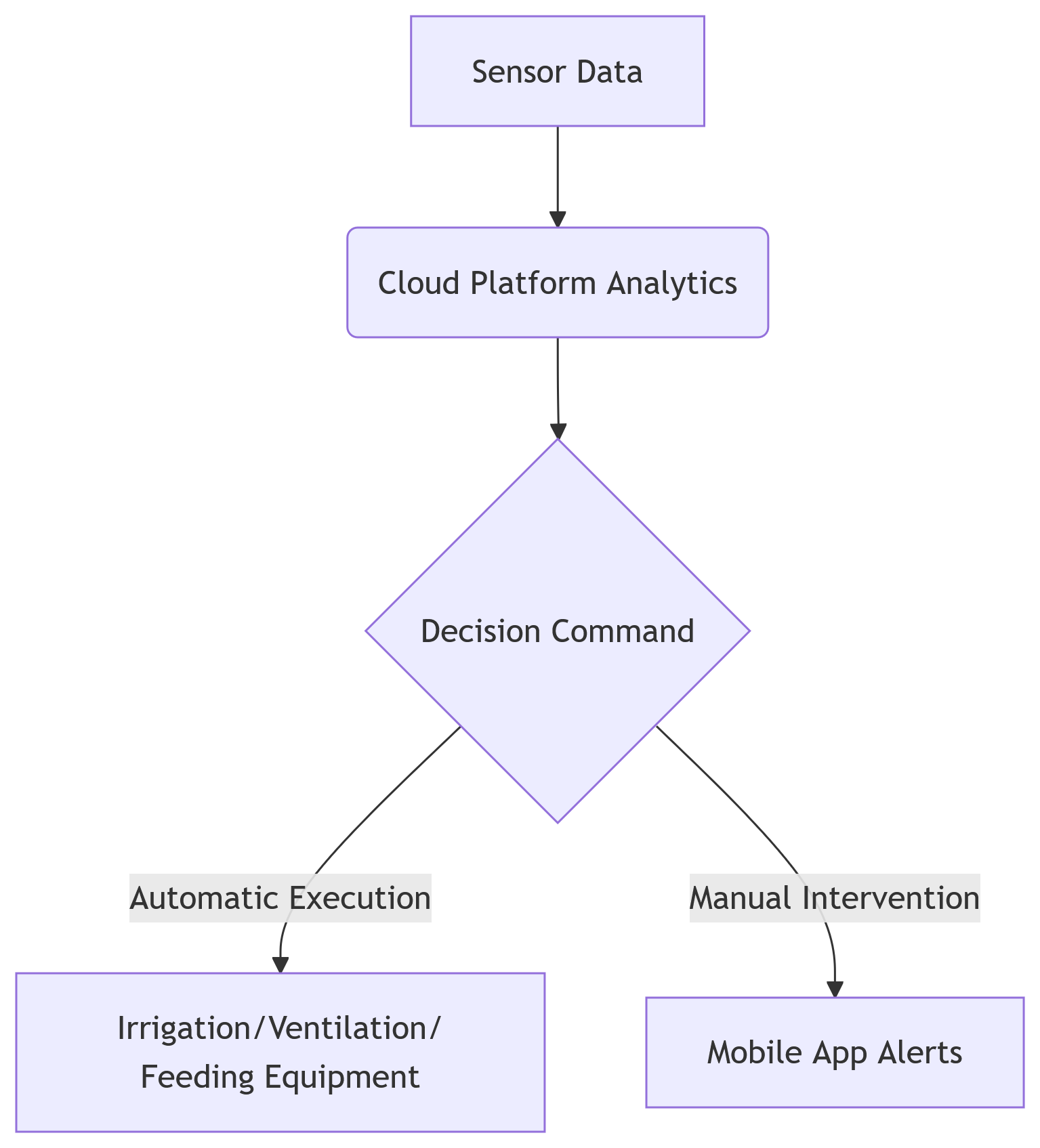
Note: Alibaba Cloud IoT platform has achieved 200ms level instruction response
3、 Transformation benefits revealed by global successful cases
1. Asia: From Small scale Farming to Technological Agriculture
-Vietnam Shrimp Farmer Revolution: Mimosa Technology Company provides IoT device rental services. Shrimp farmers control pond water salinity through a mobile app, increasing yield by 30% and reducing risk losses by 60%.
-Intelligent processing of Chinese tea: Fujian tea factories have deployed temperature and humidity sensors to monitor the fermentation environment, improving the stability of black tea quality to 98% and reducing labor costs by 40%.
2. Developed countries: exemplars of resource intensification
-Vertical Farm in Singapore: The yield per square meter is 20 times that of traditional farms, and the water consumption is reduced by 95%.
-Australian Smart Ranch: LoRa herd tracking system reduces grass waste by 35% and increases reproductive rate by 22%.
4、 Challenge and Breakthrough: The Sustainable Development Path of IoT Agriculture
1. Cost and infrastructure barriers
-Innovative business model: Vietnam adopts the “equipment cooperative leasing” model to reduce the initial investment of small farmers.
-Solar energy+low-power design: The Star Vertical intelligent sensor has a battery life of 5 years and does not require power grid support.
2. Data security and system compatibility
-Blockchain+edge computing: local processing of sensitive data, and farm uploading of desensitization information
-OPC UA Unified Architecture: Solving Cross Brand Protocol Interoperability of Agricultural Machinery/Irrigation Systems
3. Environmental sustainability balance
-Life Cycle Assessment (LCA): Preferred biodegradable sensor housing material (such as PLA plastic)
-Energy recovery design: irrigation water pump matched with micro hydro generator
5、 Future Trend: AIoT Fusion Ignites Agriculture 4.0
1. Digital Twin Farm
The experimental site of Wageningen University in the Netherlands achieved a production prediction error of less than 5% through 3D modeling and real-time sensing data.
2. Autonomous agricultural robots
Marrying IoT weeding robots (such as FarmWise) reduces pesticide use by 90%.
3. Carbon trading platform
The Internet of Things accurately measures soil carbon sequestration and generates tradable carbon credits (piloted by IBM Food Trust).
>Economists predict that by 2030, precision agriculture empowered by the Internet of Things will reduce global agricultural water consumption by 50%, lower greenhouse gas emissions by 20%, and feed an additional 1 billion people.
Action guide: Three step strategy for enterprises to layout IoT agriculture
1. Scenario based pilot: Select high-value crops (such as greenhouse strawberries) to deploy low-power sensor networks
2. Ecological Chain Cooperation: Jointly build a technology stack with Semtech (LoRa chip) and AWS IoT (cloud platform)
3. Data asset monetization: Connect desensitized agricultural data with insurance/futures companies to open up new profit models
→ [Obtain the White Paper on Agricultural IoT Solutions]
Including technology selection matrix, ROI calculation tool, and 30 benchmark cases worldwide