Table of Contents
Introduction: The Convergence of Robotics and PCB Innovation
Robotics is undergoing a transformative leap—from factory-floor arms to AI-driven humanoids—and printed circuit boards (PCBs) sit at the heart of this revolution. As robots evolve to handle complex tasks (surgery, logistics, companionship), their PCBs must deliver unprecedented signal integrity, power density, and mechanical resilience. With the global robotics PCB market projected to exceed $18.2B by 2029 , manufacturers who master these demands will lead the next wave of automation.
I. Core PCB Applications in Modern Robotics
1. Industrial Robots: Precision and Reliability
•Controller Boards: 10+ layer PCBs with impedance-controlled routing (e.g., ±5%) ensure real-time communication. For example, EtherCAT-enabled designs reduce signal cycles to 100μs, boosting welding robot precision by 20% .
•Servo Drives: Optimized power circuits cut torque ripple by 15%, enabling smoother motion in assembly arms .
•Durability: Vibration-resistant PCBs (tested at 10–500Hz, 5g acceleration) withstand harsh factory environments, achieving 80,000-hour MTBF .
2. Humanoid Robots: High-Density Integration
•Sensor Fusion: Flexible PCBs (FPCs) connect LiDAR, ToF, and environmental sensors for spatial mapping, while HDI boards with microvias route 32+ differential pairs in confined spaces .
•Value per Unit: A single humanoid robot uses ~$5,000 worth of PCB modules—primarily high-layer-count boards for processing and motor control .
3. Service & Medical Robots:
•Biometric Sensors: PCBs integrate optical/thermal sensors for user identification, with non-conductive fills preventing signal interference in humid conditions .
•Safety Compliance: Medical-grade PCBs (e.g., surgical bots) use ceramic substrates for isolation and EMI shielding to meet IEC 60601 standards.
II. Technology Drivers: What Robotics Demands from PCBs
1. Signal Integrity at High Speeds
•Material Innovation: Megtron 6 and PTFE laminates replace FR-4 for <0.5 dB/inch loss at 56+ Gbps (critical for AI-processor communication) .
•Design Rules: Huawei-inspired standards enforce 3W spacing for differential pairs and length matching (±2 mil) for DDR5/DQS clocks .
2. Mechanical & Thermal Resilience
•Flex-Rigid Hybrids: FPCs bend 500K+ cycles without failure, ideal for robotic joints .
•Thermal Management: Copper-filled vias and embedded heat spreaders dissipate 100W+ from motor drivers, reducing hotspot temps by 15°C .
3. Miniaturization via Advanced HDI
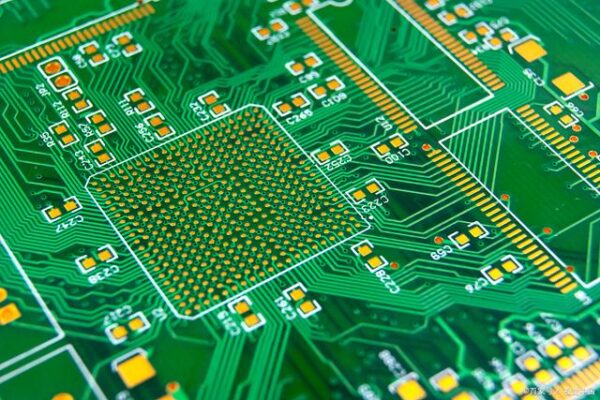
•Any-Layer Microvias: Enable via-in-pad (VIP) for 0.4mm-pitch BGAs in humanoid control boards, shrinking PCB area by 40% .
III. Market Growth and Emerging Opportunities
| Segment | PCB Requirements | Growth Projection |
| Industrial Bots | 8–12L rigid-flex, EtherCAT support | 12.4% CAGR (2025–2030) |
| Humanoids | 16+L HDI, 5K+/module value | 20%+ CAGR (driven by Tesla, Figure AI) |
| Surgical Bots | Biocompatible substrates, EMI shielding | $8.1B market by 2030 |
Key Drivers:
– Labor shortages accelerating factory automation.
– AI advancements enabling complex tasks (e.g., real-time object recognition).
– Cost reductions: Sensor/actuator prices dropping 12%/year .
IV. Future Challenges and Strategic Shifts
1. Scaling Production for Humanoid Boom
•Capacity Pressures: Leading manufacturers like Yibo Technology are expanding to support 100,000+ humanoids/year but face PCB substrate shortages .
•Solution: Partnerships with CCL suppliers (e.g., Shengyi Tech) to localize high-frequency materials.
2. Thermal & Power Density Limits
•Next-gen actuators demand 1.5KW/in² power density—exceeding current PCB capabilities.
•Innovations Needed:
–Embedded cooling channels (laser-drilled microfluidic layers).
–SiC/GaN-compatible designs for 48V motor systems.
3. AI-Driven Design and Manufacturing
•Generative AI Tools: Auto-route 1,000+ BGAs in minutes (e.g., Cadence Cerebrus), slashing R&D cycles .
•Robotic PCB Production: Delta robots assemble FPCs at 60 boards/minute, cutting labor costs by 30% .
V. Strategic Recommendations for PCB Manufacturers
1. Invest in Four Key Technologies
•Any-Layer HDI: For humanoids and micro-robots.
•High-Speed Materials: PTFE/Megtron for 5G-connected bots.
•Integrated Thermal Solutions: Vapor chambers + conductive fills.
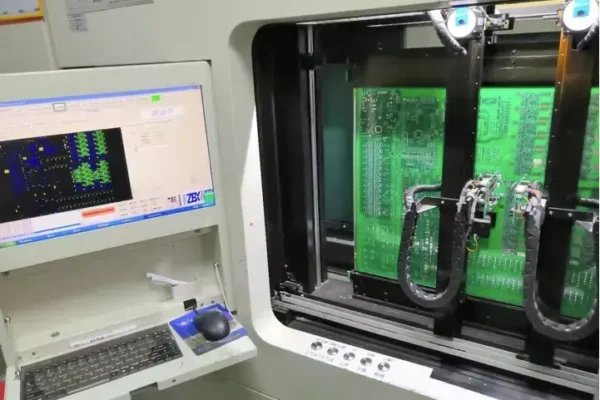
•Robotic Automation: Deploy SCARA robots for AOI inspection (efficiency: 1 board/minute) .
2. Forge Application-Specific Partnerships
•Industrial: Collaborate with KUKA/FANUC on vibration-resistant controllers.
•Humanoids: Co-develop SLAM sensor arrays with Boston Dynamics/Figure.
3. Adopt Agile Production Models
•PCB+SMT Integration: Offer end-to-end services (e.g., Fusheng Electronics’ 24-hour turnkey solutions) to attract robotics startups .
•Regional Expansion: Build factories in Thailand/Vietnam to bypass trade barriers .
Conclusion: The Robotics-PCB Symbiosis
Robotics isn’t just a market—it’s a technology catalyst forcing PCBs to evolve. Success requires:
– Material science leadership to overcome thermal/power bottlenecks.
– AI-optimized manufacturing for complex, low-volume boards.
– Early engagement with robotics innovators to co-design solutions.
The future winner will treat PCBs not as commodities, but as performance multipliers for autonomous systems.
Partner with SysPCB for robotics-grade PCBs—combining 28-layer HDI expertise, ±3% impedance control, and MIL-spec reliability. Contact us to co-create your next-gen robotic platform.