In the high-speed, micron-precision world of automated PCB assembly, machines need a way to “see” exactly where your board is. They cannot rely on the physical edges of the board, which can have variances, or on silkscreen, which is not precise enough. This is where PCB Mark come in.
These seemingly simple features are the cornerstone of manufacturing accuracy. A missing or poorly designed fiducial mark can bring a multi-million dollar SMT line to a halt, causing misaligned components, soldering defects, and catastrophic board failures.
This guide will explain what fiducial marks are, their different types, and the critical design rules you must follow to ensure flawless automated assembly.
Table of Contents
What is a PCB Mark?
A fiducial mark (or simply a “fiducial”) is a small, precise, bare copper pad on a printed circuit board that provides a visual reference point for automated assembly equipment. Think of it as a lighthouse or a landmark for a ship.
During assembly, a vision camera on the pick-and-place machine scans these marks. By comparing their actual position on the board to their predefined position in the CAD data, the machine can:
1. Calculate the exact board position and orientation (X, Y, and theta rotation).
2. Precisely compensate for any scaling or stretching that may have occurred during PCB fabrication.
3. Accurately place each component, often with an accuracy of 0.05mm or better.
Without fiducials, the machine is essentially placing components blind.
The Three Critical Types of Fiducial Marks
Not all fiducials are the same. Using the correct type is crucial for different stages of assembly.
1. Global Fiducials (Board Fiducials)
•Purpose: To align the entire PCB panel or single board.
•Location: Typically placed on the opposite corners of the board or panel, far from each other to maximize accuracy in calculating rotation.
•Requirement: Essential for every single PCB. No board should be sent to assembly without them.
2. Local Fiducials (Component-Level Fiducials)
•Purpose: To ensure ultra-precise placement of a specific, high-precision component (e.g., a fine-pitch BGA, QFN, or a large connector with many pins).
•Location: Placed near the specific component, usually on the same side of the board.
•Requirement: Used for components with a pitch of 0.5mm or less or when placement accuracy is extremely critical.
3. Panel Fiducials
•Purpose: To align the entire fabrication panel, which may contain multiple individual PCBs (multi-up panels).
•Location: Placed on the panel rails (the waste board area that is removed after assembly).
•Requirement: Used when boards are assembled in panel form.
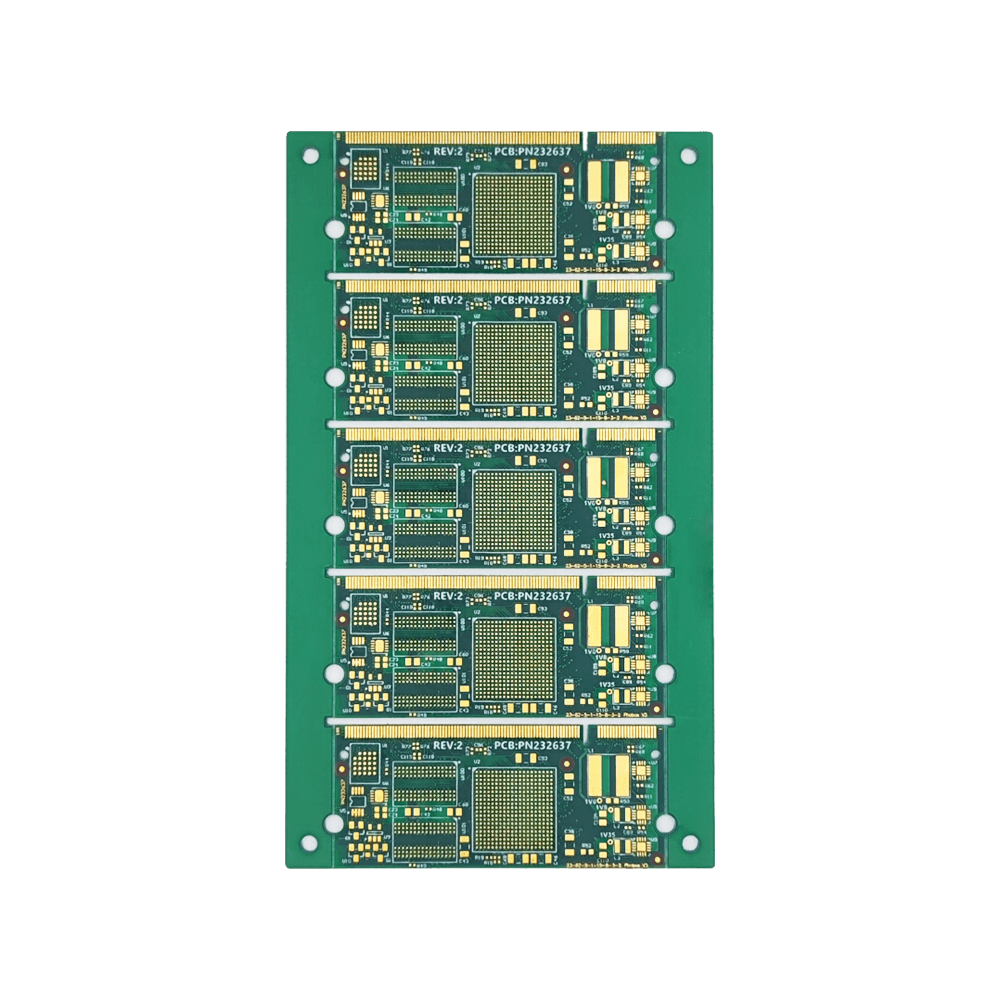
Diagram showing the location of Global, Local, and Panel Fiducials
Visual guide: Global fiducials on board corners, local fiducials near a BGA, panel fiducials on the rails.
How to Design Perfect Fiducial Marks: The Golden Rules
A poorly designed fiducial is as bad as no fiducial at all. Follow these industry-standard design rules to guarantee machine readability.
1. Size and Shape
•Recommended Size: A solid filled circle with a diameter of 1.0mm to 3.0mm (40 mils to 120 mils). 1.0mm is the most common and reliable size.
•Shape: A circle is universally preferred. It is rotationally invariant, meaning the machine can recognize it from any angle. Avoid squares, diamonds, or other shapes.
2. Clearance (The “Keep-Out” Area)
•This is the most critical rule. The fiducial must have a clear, flat, uniform background for the camera to get a high-contrast image.
•Create a keep-out area around the fiducial where NO other copper features, silkscreen, soldermask, or circuitry are allowed.
•Minimum Clearance Diameter: The clear area should be twice the diameter of the fiducial pad itself.
–Example: For a 1.0mm fiducial, ensure a 2.0mm diameter of empty space around it.
3. Surface Finish
•The fiducial pad must be a bare, flat copper surface.
•Apply a flat, non-reflective surface finish over the copper. ENIG (Electroless Nickel Immersion Gold) is the absolute best choice as it provides a matte, non-glare surface that machines can easily recognize.
•Avoid highly reflective finishes like HASL (Hot Air Solder Leveling) if possible, as they can create glare and confuse the camera. If you must use HASL, ensure the fiducial is placed on a perfectly flat area.
4. Layer Consistency
•Fiducials must be present on the same layer as the components being placed.
•If you have components on both top and bottom sides, you must have fiducials on both sides.
5. Symmetry and Placement
•Global Fiducials: Use at least three fiducials for the most robust alignment, though two in opposing corners is common. Three allows the machine to calculate all forms of distortion.
•Place them asymmetrically. If you place one in the top-left and bottom-left corners, the machine cannot calculate board rotation. Use top-left and bottom-right for a 2-fiducial system.
•Keep fiducials **at least 5mm (0.2“) away from the board edge** to ensure they are securely within the grip of the assembly machine’s rails.
Common Fiducial Design Mistakes to Avoid
| Mistake | Consequence | Solution |
| No clearance area | Soldermask or silkscreen invades the space, creating low contrast. | Enforce a strict keep-out zone in your CAD rules. |
| Wrong surface finish | Reflective HASL glare blinds the camera. | Specify ENIG for the fiducial pads or the entire board. |
| Fiducials too small | The machine’s camera cannot resolve them accurately. | Increase size to at least 1.0mm. |
| Placed under components | The PCB Mark becomes obscured after the first few parts are placed. | Always place fiducials in open space. |
| Using silk-screen | Silkscreen is not precise and can smudge or be misprinted. | Fiducials must be copper features, not ink. |
How SysPCB Ensures Perfect Fiducials
At SysPCB, we understand that design for manufacturability (DFM) is paramount. During our engineering review process, we automatically check your design for:
•Presence of Fiducials: We verify that global fiducials exist.
•Size and Clearance: We measure your fiducial pads and their keep-out zones against IPC and industry standards.
•Asymmetry: We check for proper placement to enable rotation calculation.
We help you get it right the first time, preventing costly assembly delays and ensuring your boards are built with pinpoint accuracy.