Unlock next-gen computing power with DDR4-optimized PCBs—where GHz speeds demand micron-level precision in signal routing, power delivery, and thermal management.
Table of Contents
1. DDR4 Evolution: Beyond Pins and Voltage
DDR4 isn’t just an iteration—it’s a paradigm shift in memory technology, redefining PCB design constraints:
– Pin-Count Surge: DIMM modules now use 288 pins (vs. DDR3’s 240), while So-DIMMs require 260 pins (vs. 204), enabling higher bandwidth and capacity.
– Voltage Reduction: Operates at 1.2V (down from DDR3’s 1.5V), cutting power by 20% but demanding tighter voltage tolerance (±5%).
– Bendable Edge Connectors: Curved gold fingers reduce insertion force by 40% and improve contact reliability in high-vibration environments.
– Speed Leap: Supports up to 3,200 MT/s—50% faster than DDR3—requering picosecond-level timing accuracy.

2. Layout Revolution: The Rise of Fly-by Topology
Why Fly-by Dominates DDR4
•Timing Advantage: Address/control signals cascade sequentially through DRAM chips, minimizing stub effects and enabling >2,400 Mbps speeds.
•vs. Alternatives:
| Topology | Max Freq | Best For | Drawbacks |
| Fly-by | >2,400 Mbps | Multi-chip DDR4 | Complex length matching |
| Point-to-Point | 1,600 Mbps | Single-chip designs | Limited scalability |
| T-Topology | <800 Mbps | Legacy DDR2 | Signal reflections |
Critical Placement Rules
•Controller-to-DRAM Proximity: Keep traces <2,000 mil; length mismatches >25 mil cause data eye collapse.
•VTT Termination Placement: Position pull-up resistors within 500 mil of the last DRAM chip to prevent signal reflections.
•Decoupling Capacitors: Place 0.1μF caps <100 mil from power pins; 10μF bulk caps near power entry points.
3. Routing Mastery: Taming GHz Signals
Impedance & Spacing Rules
•Single-Ended Traces (CA/DQ): Strict 50Ω ±5% impedance—deviations >7% cause 30% eye closure.
•Differential Pairs (CLK/DQS): 100Ω ±3% tolerance; length skew ≤2 mil.
•3W/5W Rule:
–DQ group traces: ≥3× line width spacing
–DQ-to-CA traces: ≥5× line width spacing
Layer Stackup Strategy
| Layer | Signal Type | Routing Technique |
| Top | Address/Control | Microstrip (4mil width, 5mil height) |
| L3/L4 | DQ/DQS Groups | Stripline (6mil width, 4mil dielectrics) |
| Bottom | VREF/VTT | Isolated copper pours |
Pro Tip: Use time-delay compensation for mixed microstrip/stripline routing:
> Compensation Length = (L_micro × 0.85) – (L_strip × 0.72)
> Reduces skew from >30ps to <8ps.
Via Optimization Techniques
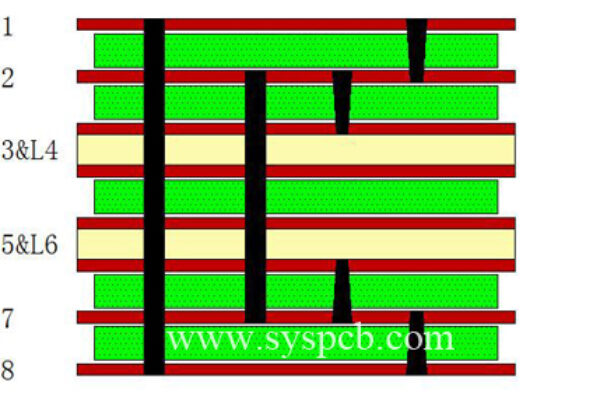
•Back-Drilling: Reduce stub lengths to ≤10 mil, lowering resonance by 26dB.
•Anti-Pads: Optimize diameter to 8–12 mil—smaller sizes increase impedance discontinuity by 18%.
•Ground Via Shielding: Ring signal vias with ground vias (40 mil spacing) to cut crosstalk by 40%.
4. Power Integrity: The Silent Enabler
DDR4’s multi-voltage ecosystem demands precision power delivery:
– VDD (1.2V): Dedicate adjacent planes with ≥20 low-ESR decoupling caps per DIMM. Plane inductance <0.5nH.
– VTT (0.6V): Use star-connected copper pours (≥120 mil width) near termination resistors. Current spikes reach 3A+.
– VREF (0.6V): Isolate with RC filters (22Ω + 10pF) and route separately to avoid noise coupling.
– VPP (2.5V): Tolerates ±7% ripple; local polygon pours suffice.
5. Manufacturing Innovations for Yield
Process Control
•Laser Direct Imaging (LDI): Achieves ±0.076mm line-width accuracy for impedance control.
•Vacuum Resin Filling: Eliminates microvia voids, surviving 10k thermal cycles (-40°C to 125°C).
•Surface Finishes: ENIG/Immersion Silver preferred over HASL for flatter pad surfaces.
Design-for-Testability
•Impedance Test Coupons: Embed line-width/spacing variants at board edges for production validation.
•TDR Probes: Place 50Ω test points on critical nets (DQS/CLK) to measure reflection coefficients <5%.
6. Simulation-Driven Validation
Avoid post-production failures with pre-layout analysis:
– Signal Integrity: Use HyperLynx/ADS to verify:
– Eye height ≥150mV for DDR4-3200
– Setup/hold margins >10% UI.
– Power Delivery Network (PDN): Target impedance <2mΩ up to 500MHz; plane resonance <–30dB.
– Thermal Stress: Model warpage under 260°C reflow; high-Tg laminates (≥170°C) reduce Z-CTE to ≤50 ppm/°C.
Conclusion: Winning the DDR4 Design Race
DDR4 transforms PCB design into a high-stakes balancing act:
– Signal Integrity: Requires Fly-by topology + micron-level length matching
– Power Integrity: Demands multi-voltage plane optimization
– Manufacturing: Relies on back-drilling and LDI for GHz-ready vias
Ready to dominate DDR4 design?
→ [Download Our DDR4 Stackup Design Kit]
→ [Request a Signal Integrity Audit]
→ [Explore Our HDI Manufacturing Capabilities]