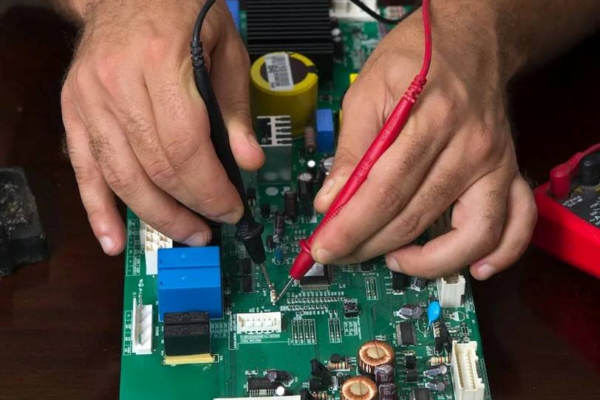
The core difference between RF circuit boards (RF circuit boards) and standard FR-4 PCBs (printed circuit boards) lies in their application scenarios – the former is designed for high-frequency RF signals (usually GHz level and above), while the latter is mainly used for low-frequency or digital circuits (MHz level and below). Therefore, there are significant differences in materials, performance, design, and cost, as follows:
Table of Contents
1. Substrate materials and electrical properties
-Standard FR-4 PCB:
The substrate is glass fiber reinforced epoxy resin (FR-4), which is currently the most commonly used low-cost PCB material. Its core electrical performance parameters:
-Dielectric constant (Dk): about 4.0-4.5, and varies greatly with frequency, temperature, and humidity (with a tolerance usually above ± 0.2);
-Loss tangent (Df, dielectric loss): about 0.015-0.02, with significant increase in loss at high frequencies (such as GHz level);
These characteristics result in severe attenuation of high-frequency signals by FR-4, making it unsuitable for RF applications.
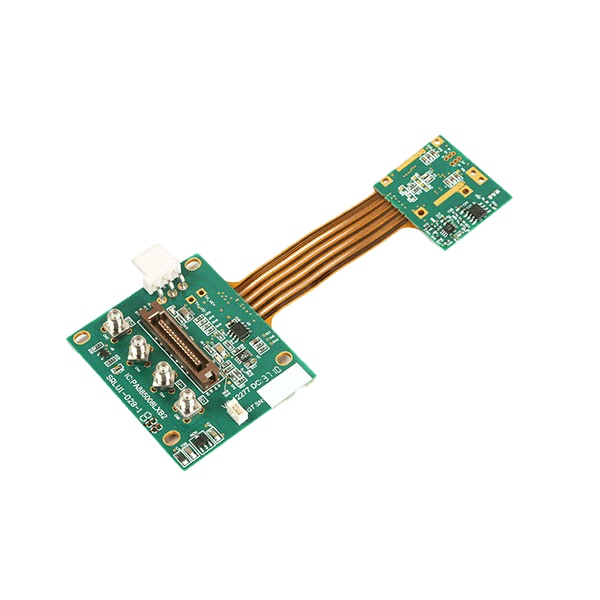
-RF circuit board:
Low loss high-frequency substrates such as PTFE (polytetrafluoroethylene), Rogers (RO4350, RO4003), Arlon, or Taconic are commonly used. Its core electrical performance:
-Dielectric constant (Dk): low and stable (such as 2.2-3.5), with minimal tolerance (usually within ± 0.05), ensuring high frequency signal transmission speed and impedance stability;
-Loss tangent (Df): extremely low (0.002-0.004), can significantly reduce the dielectric loss of high-frequency signals and avoid signal attenuation.
2. Loss characteristics
The loss of high-frequency signals (RF) mainly comes from dielectric loss (determined by Df) and conductor loss (caused by skin effect):
-Standard FR-4 PCB: Df is relatively high, and the copper foil surface is rough (mainly electrolytic copper). At high frequencies, the skin effect will amplify surface loss, resulting in severe signal attenuation (such as at 10GHz, the loss of FR-4 may be 5-10 times that of RF substrate).
-RF circuit board: using low Df substrate to reduce dielectric loss, while using smooth rolled copper foil (instead of rough electrolytic copper), and even silver/gold plating to reduce surface resistance and minimize conductor loss caused by skin effect.
3. Impedance control accuracy
The wavelength of RF signals shortens with increasing frequency (such as 1GHz signals with a wavelength of about 30cm and 10GHz signals with a wavelength of about 3cm), and the length of PCB wiring may be equivalent to the wavelength. At this time, impedance matching is the core (strictly controlled to standard impedances such as 50 Ω and 75 Ω), otherwise reflection and standing waves will occur, resulting in signal distortion or power loss.
-Standard FR-4 PCB: has low requirements for impedance control (usually with a tolerance of ± 10% or more), only needs to meet the basic integrity of low-frequency digital signals (such as crosstalk and time delay), and does not require strict matching.
-RF circuit board: With extremely high impedance control accuracy (tolerance within ± 5%), it relies on the stability of substrate Dk and precise control of dielectric thickness (lamination tolerance ± 0.01mm) to ensure consistent impedance of transmission lines (microstrip lines, coplanar waveguides, etc.).
4. Design and process requirements
-Transmission line design: RF circuit boards require precise design of transmission line structures (such as microstrip lines, strip lines, coplanar waveguides), with short and straight wiring to avoid corners (or use rounded corners) and reduce signal reflection; FR-4 PCB mainly focuses on wiring density and digital timing, with no special requirements for transmission line structure.
-Shielding and EMI/EMC: RF signal radiation is strong, and RF circuit boards often require metal shielding covers (or inner shielding layers) to reduce interference; The EMI problem of FR-4 PCB is relatively mild and can usually be alleviated through a ground plane.
-Conductor treatment: RF circuit boards use high smoothness rolled copper foil (surface roughness<1 μ m) or even silver/gold plating (conductivity better than copper) to reduce skin effect losses; FR-4 PCB is mostly made of electrolytic copper (with a rough surface and low cost), and the coating is relatively thin.
5. Application scenarios

-Standard FR-4 PCB: Suitable for low-frequency analog circuits (such as power supplies, audio), digital circuits (such as microcontrollers, MCUs, interface circuits), with operating frequencies typically<100MHz, pursuing low cost and versatility.
-RF circuit board: suitable for RF/microwave systems (such as 5G/6G communication, radar, satellite navigation, wireless RF modules), operating frequency ≥ 1GHz, ensuring low signal loss and high fidelity transmission.
6. Cost and Processing
-Standard FR-4 PCB: With extremely low material and processing costs (about a few yuan/square centimeter), it is suitable for large-scale production.
-RF circuit board: The cost of high-frequency substrates (such as Rogers) is 10-50 times that of FR-4, and the processing requires high-precision control (such as lamination, drilling, impedance testing), resulting in significantly higher total costs (tens to hundreds of yuan/square centimeter).
Summarize
RF circuit board is a “high-precision, low loss” solution optimized for high-frequency RF signals, with core differences reflected in substrate performance (low loss, high stability), impedance control accuracy, and loss characteristics; FR-4 PCB is a low-cost universal solution that is only suitable for low-frequency or digital circuits. When choosing, it is necessary to weigh the operating frequency, signal loss requirements, and cost.
Get your exclusive quote immediately: fill out the form or send an email directly.As a professional PCB manufacturer for hobbyist , we will provide you with a quote service within 24 hours. Enjoy free DFM optimization and a 10% discount on SMT patches for your first order!