RF microwave technology in PCB (printed circuit board) is a technology specifically designed for the transmission, processing, and conversion of high-frequency signals (usually above 300MHz, with microwave frequency bands ranging from GHz to THz). It is widely used in communication (such as 5G/6G base stations, satellite communication), radar, IoT, aerospace, and other fields. Unlike low-frequency PCBs, RF microwave PCBs need to address core issues such as signal integrity, loss, and impedance matching, and their design and manufacturing have significant particularities.
Table of Contents
1、 Core characteristics of RF microwave PCB
The wavelength of high-frequency signals is relatively short (such as a 1GHz signal wavelength of about 30cm and a 10GHz signal wavelength of about 3cm). When the PCB size is comparable to the signal wavelength, it will exhibit distributed parameter effects (the signal is no longer “concentrated” along the wire, but propagates in the form of electromagnetic waves in the medium). Therefore, the following requirements must be met:
-Impedance matching: The characteristic impedance of the transmission line needs to be matched with the source and load (usually 50 Ω, 75 Ω), otherwise reflection will occur, resulting in signal attenuation or distortion.
-Low loss: Significant dielectric loss (Df) and conductor loss (skin effect) at high frequencies require the selection of low loss materials.
-Signal integrity: Avoid crosstalk, radiated interference (EMI), control signal delay and phase shift.
-Stability: The dielectric constant (Dk) and thermal expansion coefficient of the material need to vary minimally with frequency and temperature to ensure stable performance.
2、 Key technical elements of RF microwave PCB
1. Transmission line design
RF microwave signals propagate through specific transmission lines in PCBs, and common types include:
-Microstrip Line: Composed of a conductor strip, a dielectric substrate, and a ground plane, it has a simple structure, low cost, and is suitable for frequency bands above 1 GHz, but is susceptible to external interference.
-Characteristics: Impedance is determined by line width, dielectric thickness, and dielectric constant (formula: \ (Z-0=\ frac {87} {\ sqrt {Dk+1.41}} \ ln (\ frac {5.98h} {0.8w+t}) \), where \ (h \) is the dielectric thickness\ (w \) is the line width.
-Stripline: The conductor strip is wrapped in two layers of ground planes and dielectric, with strong anti-interference ability, suitable for high frequencies (above 10GHz), but with slightly higher losses than microstrip lines.
-Coplanar waveguide (CPW): The conductor strip has grounding planes on both sides and does not require bottom grounding. It is suitable for integrating active devices (such as MMICs), but has high radiation losses.
-Differential line: It cancels out noise through a pair of reverse transmission signal lines and is suitable for high-speed differential signals (such as RF data transmission).
2. Material selection
The material properties at high frequencies have a significant impact on the signal, and the core parameters include:
-Dielectric constant (Dk): It needs to be stable and uniform (such as ceramic filling material Dk=3.0-10.0) to avoid inconsistent signal propagation speeds.
-Dielectric loss factor (Df): characterizes the absorption of high-frequency signals by the medium, and a smaller Df is better (such as PTFE material with Df<0.001, suitable for millimeter wave frequency band).
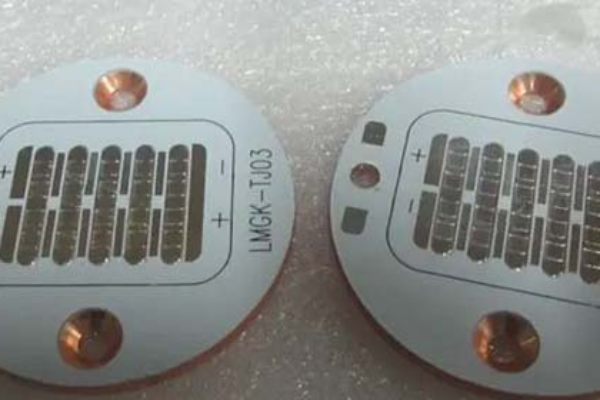
-Thermal conductivity: High frequency devices generate a large amount of heat and require high thermal conductivity materials (such as aluminum based PCBs) for heat dissipation.
-Common materials:
-Low frequency radio frequency (<10GHz): FR-4 (low cost, Df≈0.02, Suitable for civilian equipment.
-High frequency microwave (10GHz-60GHz): PTFE (polytetrafluoroethylene), Rogers series plates (such as RO4350B, Dk=3.48, Df=0.0037).
-Millimeter wave (>60GHz): ceramic substrate, sapphire substrate (extremely low loss, high cost).
3. Impedance matching technology
Impedance mismatch can cause signal reflection (reflection coefficient \ (Gamma=\ frac {Z_L – Z-0} {Z_L+Z-0} \), reduce transmission efficiency, and even damage the device. Common matching methods:
-Aggregate parameter matching: using patch resistors, capacitors, and inductors to form π – and T-shaped networks, suitable for low frequency bands (<10GHz).
-Distributed parameter matching: achieved through transmission line structures such as λ/4 impedance converters and gradient lines, suitable for high frequency bands (where λ is the signal wavelength).
-Software simulation optimization: Simulate impedance curves using tools such as ADS and HFSS, adjust transmission line size or add matching components.
4. Heat dissipation and shielding design
-Heat dissipation: RF power devices (such as power amplifiers) generate intense heat during operation and require:
-Thickened copper foil (above 2oz) reduces conductor resistance and enhances heat dissipation.
-Metallic vias conduct heat from the top layer to the bottom ground plane or heat sink.
-Using aluminum or copper based PCB, directly in contact with the metal casing for heat dissipation.
-Shielding: High frequency signals are prone to radiation interference and require:
-Metal shielding cavity (covering sensitive circuits such as oscillators and mixers).
-Ground plane integrity (avoiding ground plane segmentation and reducing impedance transients).
-Absorbing material (attached to the surface of PCB to absorb radiation energy).
3、 Manufacturing challenges of RF microwave PCB
1. High precision machining:
-The transmission line width tolerance should be controlled within ± 0.02mm (otherwise the impedance deviation exceeds 5%).
-Uniformity of dielectric layer thickness (error<5%) to avoid uneven distribution of Dk.
2. Metal surface treatment:
-The skin effect causes high-frequency currents to concentrate on the surface of the conductor (the skin depth of copper is about 1 μ m at 10GHz), requiring electroplating of low resistivity metals such as silver and gold to reduce losses.
3. Through hole design:
-Through holes can introduce parasitic inductance and capacitance. At high frequencies, “blind holes” or “buried holes” should be used or the diameter of the through holes should be reduced (such as below 0.2mm), and grounding through holes should be added to surround the signal through holes to reduce radiation.
4、 Application scenarios
-In the field of communication: RF front-end modules for 5G base stations (power amplification, filtering, antenna feeders), and transceiver PCBs for satellite communication.
-Radar system: signal processing board for millimeter wave radar (target detection, imaging).
-Consumer electronics: WiFi 6/7 router, Bluetooth module, drone image transmission PCB.
-Aerospace: Anti radiation RF PCB (suitable for extreme temperature and vibration environments).
Summarize
The core of RF microwave PCB technology is to balance signal transmission efficiency, loss control, and environmental adaptability, and its design needs to combine electromagnetic field theory, material science, and precision manufacturing technology. With the development of technologies such as 6G and millimeter wave radar, higher requirements have been put forward for the high-frequency performance (such as frequencies above 100GHz) and integration (co packaging with antennas and chips) of PCBs, driving breakthroughs in new technologies such as low loss materials and 3D integration.
Get your exclusive quote immediately: fill out the form or send an email directly.As a professional PCB manufacturer for hobbyist , we will provide you with a quote service within 24 hours. Enjoy free DFM optimization and a 10% discount on SMT patches for your first order!