Table of Contents
Executive Summary
Quartz crystal oscillators represent one of the most critical components in modern electronic circuit design, providing precise timing references and stable frequency control across countless applications. These components leverage the piezoelectric effect of quartz crystal to generate consistent oscillations with exceptional accuracy and stability. For PCB manufacturers and designers, understanding quartz crystal technology—from fundamental operating principles to advanced implementation considerations—is essential for developing reliable electronic systems. This comprehensive guide explores the various types of quartz crystal oscillators, their key parameters, application-specific selection criteria, and critical PCB layout considerations that ensure optimal performance in everything from consumer electronics to industrial systems and IoT devices.
1.Understanding Quartz Crystal Technology
1.1 Fundamental Operating Principles
Quartz crystal oscillators function based on the piezoelectric effect—a unique property where mechanical stress on quartz crystal generates an electrical charge, and conversely, an applied electrical field causes mechanical deformation. When an alternating voltage is applied to a quartz crystal, it vibrates at a remarkably stable resonant frequency determined by its physical dimensions and cut. This vibration creates a highly precise electrical signal that serves as a timing reference for electronic circuits .
The exceptional frequency stability of quartz crystals stems from the inherent physical properties of quartz material. Unlike other electronic components whose characteristics may drift with temperature variations or aging, quartz crystals maintain consistent performance over time and environmental changes. This reliability makes them indispensable for applications requiring accurate timing, from simple clock generation to sophisticated communication systems where precise frequency synchronization is critical .
1.2 Crystal Cut Types and Their Characteristics
The performance characteristics of quartz crystals vary significantly based on their physical orientation and cutting method. The AT-cut is among the most common crystal cuts, offering excellent frequency stability across a wide temperature range with relatively low cost, making it suitable for general-purpose applications ranging from 1 MHz to 300 MHz. For applications requiring even better temperature performance, SC-cut crystals provide superior characteristics but at higher cost, typically used in oven-controlled oscillators where maximum stability is essential .
Other specialized cuts include BT-cut crystals, which operate at higher frequencies than AT-cut equivalents but with slightly reduced temperature performance, and tuning fork crystals used primarily for low-frequency applications such as 32.768 kHz timing references in real-time clocks. The choice of crystal cut represents a fundamental design decision that balances frequency range, temperature stability, size constraints, and cost considerations for each specific application .
2.Types of Quartz Crystal Oscillators
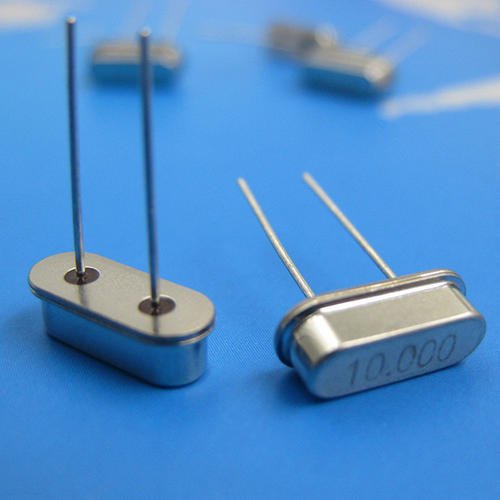
2.1 Crystal Resonators (XOs)
Crystal resonators (XOs) represent the most basic form of quartz crystal components, consisting of a quartz crystal blank with electrodes attached and housed in a protective package. These devices require external circuitry to sustain oscillation but provide a fundamental frequency reference at the lowest cost and complexity. Common examples include the 02KR-8M-P quartz crystal resonator with a nominal frequency of 8.000 MHz, frequency tolerance of ±30 ppm, and load capacitance of 18 pF or 20 pF, typically used as clock sources for microcontrollers and microprocessors .
These resonators are further categorized by their oscillation mode. Fundamental mode crystals operate at their lowest natural resonant frequency, while overtone crystals are designed to operate at integer multiples of their fundamental frequency, enabling higher frequency operation without excessively thinning the quartz blank, which would compromise mechanical strength. For instance, the QC5A series of quartz crystal units supports both fundamental mode (8.000 to 52.000 MHz) and third overtone operation (40.000 to 160.000 MHz) in compact 3.2×5.0mm 4-pad SMD packages .
2.2 Temperature-Compensated Crystal Oscillators (TCXOs)
Temperature-compensated crystal oscillators (TCXOs) incorporate specialized circuitry that actively compensates for frequency variations caused by temperature changes. These devices typically employ temperature-sensing components and variable reactance networks that adjust the oscillation frequency to maintain stability across the operating temperature range. TCXOs can achieve frequency stabilities of ±0.5 ppm to ±5 ppm over industrial temperature ranges, significantly better than the ±10 ppm to ±100 ppm stability of standard crystal resonators .
The enhanced performance of TCXOs makes them particularly valuable for applications where temperature fluctuations would otherwise compromise system functionality. Wireless communication systems, GPS receivers, and precision instrumentation all benefit from the stable frequency references provided by TCXOs. While more expensive than basic crystal resonators, TCXOs eliminate the need for complex external compensation circuits, ultimately reducing total system cost in demanding applications .
2.3 Oven-Controlled Crystal Oscillators (OCXOs)
Oven-controlled crystal oscillators (OCXOs) represent the highest tier of frequency stability among quartz crystal devices. These sophisticated components maintain the crystal at a constant elevated temperature using an integrated heating element and temperature control circuitry, effectively eliminating frequency variations caused by ambient temperature changes. OCXOs achieve exceptional stabilities ranging from ±0.001 ppm to ±0.1 ppm over their specified temperature ranges, outperforming both standard resonators and TCXOs .
The superior performance of OCXOs comes with trade-offs including higher power consumption, larger physical size, and significantly greater cost compared to other crystal oscillator types. These characteristics make OCXOs suitable for applications where extreme frequency stability justifies the additional resources, such as cellular base stations, precision test equipment, navigation systems, and high-reliability military and aerospace electronics .
2.4 Voltage-Controlled Crystal Oscillators (VCXOs)
Voltage-controlled crystal oscillators (VCXOs) incorporate a tuning capability that allows their output frequency to be adjusted by applying a control voltage. While offering less absolute frequency stability than TCXOs or OCXOs, VCXOs provide the critical functionality of frequency adjustment necessary for phase-locked loops (PLLs), clock recovery circuits, and synchronization systems. The pullability of a VCXO—the range over which its frequency can be adjusted—typically ranges from tens to hundreds of parts per million relative to the center frequency .
This adjustable frequency capability makes VCXOs essential components in telecommunications equipment, data transmission systems, and digital video interfaces where clock signals must synchronize with external references. Designers must balance the frequency pull range against stability requirements, as increased pullability generally compromises overall frequency stability in VCXO implementations .
Table: Comparison of Quartz Crystal Oscillator Types
| Oscillator Type | Frequency Stability | Power Consumption | Relative Cost | Typical Applications |
| Crystal Resonator (XO) | ±10 ppm to ±100 ppm | Low | Low | Microcontrollers, consumer electronics |
| TCXO | ±0.5 ppm to ±5 ppm | Low to Moderate | Moderate | Mobile devices, GPS, wireless systems |
| VCXO | ±10 ppm to ±100 ppm | Low | Low to Moderate | PLLs, clock recovery, synchronization |
| OCXO | ±0.001 ppm to ±0.1 ppm | High | High | Base stations, test equipment, military |
3.Key Parameters and Specifications
3.1 Frequency Accuracy and Stability
Frequency accuracy and stability represent fundamental performance parameters for quartz crystal oscillators. The frequency tolerance specifies the maximum allowable deviation from the nominal frequency at a reference temperature (typically 25°C), commonly expressed in parts per million (ppm). For example, a ±30 ppm tolerance for a 24 MHz oscillator allows variation of ±720 Hz from the nominal frequency . The frequency stability defines how much the frequency may drift across the entire operating temperature range, also specified in ppm.
Different applications demand varying levels of frequency precision. Consumer electronics such as smartphones and wearable devices may tolerate ±50 ppm stability, while communication infrastructure and industrial systems often require ±10 ppm or better. Understanding these requirements is essential for selecting appropriate crystal oscillator types and avoiding both over-specification that increases cost and under-specification that compromises system performance .
3.2 Load Capacitance and Drive Level
Load capacitance represents a critical parameter for crystal resonators, defining the external capacitance required across the crystal terminals for operation at the specified frequency. Standard values typically range from 12 pF to 32 pF, with the actual value significantly influencing the oscillation frequency. Mismatched load capacitance can cause frequency errors exceeding the specified tolerance, making proper capacitor selection essential for achieving desired performance .
The drive level specifies the maximum power that a crystal can safely dissipate during operation, typically measured in microwatts (μW) or milliwatts (mW). Excessive drive level can accelerate aging, cause frequency shifts, or even damage the crystal, while insufficient drive may prevent reliable oscillation startup. Most crystal resonators specify maximum drive levels between 100 μW and 500 μW, with modern low-power designs supporting even lower levels for battery-operated applications .
3.3 Environmental Specifications
Operating temperature range defines the environmental conditions under which a crystal oscillator will meet its specified performance. Commercial-grade components typically span 0°C to 70°C or -20°C to +70°C, while industrial-grade devices cover -40°C to +85°C. Extended and automotive temperature ranges reaching -40°C to +105°C or -40°C to +125°C are available for harsh environments .
Additional environmental considerations include shock and vibration resistance, particularly for mobile, automotive, and aerospace applications. The aging rate specifies how much the frequency changes per year due to internal material changes, typically ranging from ±1 ppm/year to ±5 ppm/year for standard crystals and down to ±0.1 ppm/year for premium devices. These parameters collectively determine the long-term reliability and environmental robustness of crystal oscillators in their target applications .
4.Application-Specific Considerations
4.1 IoT and Consumer Electronics
The Internet of Things (IoT) represents a growing application segment for quartz crystal oscillators, particularly demanding small form factors, low power consumption, and cost efficiency. IoT devices such as video surveillance systems, electronic tags, and smart locks commonly employ compact crystal resonators with frequencies tailored to their specific communication protocols and processing requirements . The 32.768 kHz crystal oscillator has become particularly significant for real-time clock (RTC) functionality in battery-powered IoT devices, with the global market for these components projected to grow from approximately 142 billion RMB in 2024 to 232.2 billion RMB by 2031, reflecting a compound annual growth rate of 7.3% .
Consumer electronics place additional emphasis on miniaturization, with crystal packages shrinking to 2.0mm × 1.6mm and smaller while maintaining reliable performance. Low-current crystal oscillators like the HEA series from Majuli, consuming only 6μA typical current, enable extended battery life in portable and wearable devices . These applications typically balance performance requirements with aggressive cost targets, driving innovation in manufacturing processes and material technologies.
4.2 Industrial and Automotive Systems
Industrial control systems demand crystal oscillators with enhanced reliability, extended temperature tolerance, and superior frequency stability. The recent T/CIET 1266—2025 technical specification for industrial control crystal oscillators establishes comprehensive requirements for general specifications, technical requirements, test methods, and inspection rules, reflecting the critical nature of these components in industrial applications . Standard industrial temperature ranges of -40°C to +85°C ensure proper operation in manufacturing environments with significant thermal variation.
Automotive electronics represent another demanding application area, requiring components that withstand harsh operating conditions while maintaining precise timing for safety-critical systems. AEC-Q200 qualification has become the standard for automotive-grade crystal oscillators, ensuring reliability across temperature extremes, mechanical vibration, and long service life. These components must maintain stability despite under-hood temperatures that can exceed 125°C while powering advanced driver assistance systems (ADAS), infotainment systems, and vehicle control networks .
4.3 Communications and Networking
Communication equipment places among the most stringent demands on quartz crystal oscillators, particularly regarding frequency stability, phase noise, and jitter. Wireless infrastructure including 5G base stations requires TCXOs and OCXOs with stabilities better than ±0.1 ppm to maintain network synchronization and minimize interference. Network routing and switching equipment similarly depends on precise timing to manage data flow and maintain synchronization across network segments .
The continuing expansion of network bandwidth to 100G, 400G, and beyond drives demand for higher-frequency crystal oscillators with superior phase noise characteristics. These applications increasingly employ specialized oscillator types including differential oscillators that provide improved noise immunity in high-speed digital systems, and LVDS oscillators that support faster edge rates while reducing electromagnetic interference in sensitive radio frequency applications .
5.PCB Design Considerations
5.1 Layout and Routing Guidelines
Proper PCB layout is essential for optimizing crystal oscillator performance and reliability. The crystal should be positioned as close as possible to the associated IC pins to minimize trace length, with a general guideline keeping total trace length under 5mm for frequencies above 20 MHz. Ground planes should surround oscillator traces to provide shielding and reduce electromagnetic interference, though the area directly beneath the crystal package should typically remain clear of copper to prevent parasitic capacitance .
Differential routing practices should be applied to the crystal traces, maintaining consistent spacing and avoiding sharp corners that can introduce impedance discontinuities. Vias should be minimized in oscillator circuits, particularly between the crystal and its load capacitors, as each via introduces additional inductance and potential impedance mismatches. Following these layout principles significantly improves startup reliability, frequency accuracy, and phase noise performance in crystal oscillator circuits .
5.2 Component Selection and Placement
Load capacitor selection and placement critically impact crystal oscillator frequency accuracy and stability. These capacitors should be located immediately adjacent to the crystal pins, with symmetrical placement relative to the crystal package. Ceramic capacitors with COG/NP0 dielectric provide the best performance for crystal circuits due to their stable capacitance values across temperature and voltage variations .
Many modern microcontrollers incorporate integrated load capacitors, simplifying design but offering less adjustment flexibility. When external capacitors are required, their value can be calculated based on the specified load capacitance, accounting for PCB stray capacitance (typically 2-5 pF). For crystals specifying 12 pF load capacitance with 3 pF stray capacitance, two 18 pF capacitors (Cs = 2 × (CL – Cstray) = 2 × (12 – 3) = 18 pF) would provide the appropriate loading .
5.3 Noise and Interference Mitigation
Grounding strategies significantly influence crystal oscillator performance in noise-sensitive applications. A single-point ground connection for the crystal circuit prevents ground loops that can introduce noise, while guard rings surrounding the oscillator circuit provide additional isolation from digital switching noise. Power supply decoupling is equally critical, with a dedicated bypass capacitor (typically 0.1 μF) placed near the oscillator power pin and connected directly to the ground plane .
In particularly noise-sensitive applications, shield cans may be employed to fully enclose the crystal and its associated circuitry, providing maximum isolation from external interference. The crystal case should be grounded to the PCB ground plane, either through dedicated grounding pads on the package or via the natural capacitance between the case and ground plane. These measures collectively improve signal integrity and reduce the system’s susceptibility to electromagnetic interference .
6.Market Trends and Future Outlook
6.1 Miniaturization and Integration
The continuing trend toward electronic miniaturization drives development of increasingly compact crystal packages, with current mainstream SMD sizes of 2.5mm × 2.0mm and 3.2mm × 2.5mm giving way to 2.0mm × 1.6mm, 1.6mm × 1.2mm, and even smaller form factors. This miniaturization presents significant engineering challenges in maintaining frequency stability, shock resistance, and manufacturability as quartz blanks become thinner and more fragile .
System-in-Package (SiP) solutions represent another emerging trend, integrating crystal oscillators with other components such as temperature sensors, voltage regulators, and buffer circuits within single packages. These integrated solutions simplify PCB design, reduce total component count, and improve system reliability, though often at higher unit cost than discrete implementations. The optimal balance between integration and discrete implementation varies by application requirements and production volume .
6.2 Emerging Technologies and Alternatives
MEMS (Micro-Electro-Mechanical Systems) oscillator technology continues to evolve as an alternative to traditional quartz crystals, offering improved shock resistance, faster startup times, and greater integration potential. While MEMS devices have historically trailed quartz in frequency stability and phase noise performance, recent advances have narrowed this gap, particularly for consumer applications where ±50 ppm stability is acceptable .
Despite these emerging technologies, quartz crystal oscillators maintain dominance in applications requiring the highest frequency stability, benefiting from ongoing material science and manufacturing innovations. Advanced crystal cuts and hybrid oscillator designs combining quartz resonators with sophisticated compensation circuitry continue to push performance boundaries, ensuring quartz technology remains relevant for the foreseeable future across diverse electronic applications .
7.Conclusion
Quartz crystal oscillators remain indispensable components in modern electronic design, providing the precise timing references essential for everything from simple microcontrollers to sophisticated communication systems. Understanding the various oscillator types—from basic crystal resonators to temperature-compensated and oven-controlled variants—enables designers to select optimal solutions for their specific performance, environmental, and cost requirements.
For PCB manufacturers and designers, successful crystal oscillator implementation requires careful attention to layout, component selection, and noise mitigation strategies. As electronic systems continue evolving toward higher speeds, greater integration, and more demanding operating environments, quartz crystal technology similarly advances to meet these challenges through ongoing miniaturization, enhanced stability, and improved reliability across diverse application scenarios.
Partner with Us for Your PCB Manufacturing Needs
Our expertise in high-frequency PCB design and precision manufacturing ensures optimal implementation of quartz crystal oscillators in your electronic systems. With specialized capabilities in impedance control, EMI mitigation, and thermal management, we deliver PCB solutions that maximize the performance and reliability of your timing circuits.
Contact us today to discuss how we can support your next project with advanced PCB technology tailored for your specific crystal oscillator requirements and application needs.