Inductive proximity switch sensor: working principle, characteristics, and electrical specifications
Inductive proximity switch is a widely used non-contact sensor in the field of industrial automation, mainly used to detect the presence, position or motion status of metal objects. Its core advantage lies in achieving efficient and stable signal output without direct contact with the detection object, making it indispensable in scenarios such as mechanical manufacturing, logistics warehousing, and automated production lines.
Table of Contents
Ⅰ.Working principle: Non contact detection based on electromagnetic induction
The working principle of inductive proximity switch is essentially the law of electromagnetic induction. The core structure includes four parts: high-frequency oscillation circuit, amplification circuit, trigger circuit, and output circuit. The specific process is as follows:
1. High frequency electromagnetic field generation: The oscillator inside the sensor (composed of a coil and a capacitor) generates high-frequency alternating current, which forms a high-frequency alternating electromagnetic field through the detection coil (located at the front end of the sensor). The electromagnetic field covers the “detection area” of the sensor (usually a few millimeters to tens of millimeters at the front end).

2. Eddy current effect of metal objects: When a metal object enters the detection area, an alternating electromagnetic field will induce eddy currents (closed induced currents) inside the metal. Eddy currents will generate an “anti magnetic field” in the opposite direction to the original electromagnetic field, weakening the energy of the original oscillating circuit.
3. State changes of oscillation circuit: The effect of the anti magnetic field can increase the energy loss of the oscillation circuit. If the metal object is close enough (less than the rated detection distance), the oscillation will be severely attenuated or even stopped.
4. Signal output: The amplification circuit converts the change in oscillation state (from “oscillation” to “stop oscillation”) into an electrical signal, and the triggering circuit drives the output circuit (such as a transistor or relay) according to the signal change, outputting a switch signal (high/low level or on/off state), indicating “object detected”.
Ⅱ. Core feature: Performance advantages adapted to industrial scenarios
The characteristics of inductive proximity switches make them irreplaceable in industrial environments, with the following main features:
1. Non contact detection, long lifespan: No need to come into contact with metal objects, avoiding wear and tear caused by mechanical wear and collision. The service life can reach tens of thousands to millions of times, far higher than mechanical contact switches (such as travel switches).
2. Only sensitive to metals: The detection object is limited to metals (iron, steel, copper, aluminum, etc.) and has no response to non-metallic objects (plastic, wood, liquids, etc.), which can effectively avoid interference from unrelated objects in the environment.
3. Fast response speed: The delay from detecting an object to outputting a signal is extremely short (usually in microseconds), and the response frequency can reach 100Hz to 2000Hz, which can adapt to the detection of high-speed moving objects (such as counting metal workpieces on conveyor belts).
4. Strong environmental adaptability: The shell is mostly made of metal (brass, stainless steel) or high-strength plastic, with a protection level of IP65/IP67 (dustproof, waterproof), which can work stably in harsh environments such as dust, oil stains, and humidity; Some models can withstand a wide temperature range of -40 ℃ to 85 ℃.
5. Flexible installation, high precision: compact size (diameter 3mm to 30mm, or square/flat), can be embedded in mechanical structures; High repeat positioning accuracy (usually within 1% of the detection distance), suitable for high-precision positioning scenarios (such as machine tool limit).
6. Diverse output modes: Supports multiple output types such as NPN, PNP, relays, etc., and can be directly connected to control systems such as PLC, microcontroller, relays, etc., with strong compatibility.
Ⅲ.Electrical specifications: key parameters and selection criteria
Electrical specifications are the core basis for selecting inductive proximity switches, mainly including the following parameters:
1. Power supply voltage:
-Direct Current (DC): The common range is 10-30V DC (suitable for industrial DC power supplies), and some micro models support 5V DC (suitable for microcontroller systems).
-Communication (AC): The common range is 24-240V AC (suitable for mains or industrial AC power sources), but the response speed is slightly lower than that of DC models.
2. Output type:
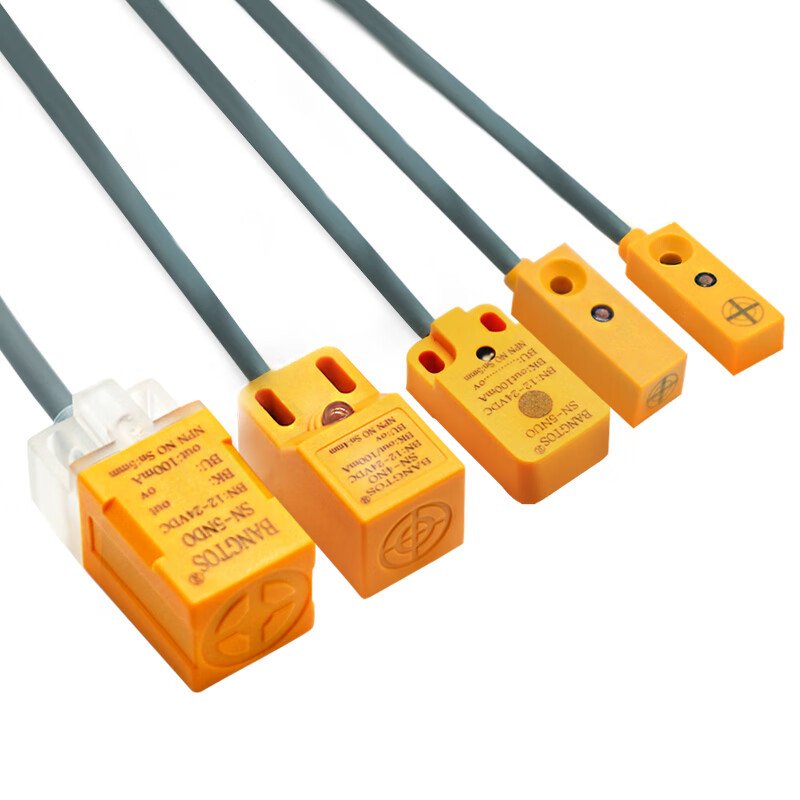
-Transistor output: divided into NPN (effective output low level) and PNP (effective output high level), both are electronic switches suitable for driving low-power loads (such as PLC input modules), with fast switching speed.
-Relay output: It outputs through contacts, has no polarity, can drive AC or DC loads, but has a slow response speed (in milliseconds).
-Output status: Supports normally open (NO, disconnected when no object is detected, closed when object is detected) and normally closed (NC, closed when no object is detected, disconnected when object is detected), some models can be switched through wiring.
3. Rated output current:
The output of the transistor is usually 100mA-500mA (to avoid overload and burnout); The output contact capacity of a relay is usually between 1A and 5A (AC 250V or DC 30V).
4. Detection distance (Sn):
The maximum distance at which the sensor can stably detect standard metals (usually iron) is the core parameter, with a common range of 1mm-80mm (such as about 4mm for M12 models and about 15mm for M30 models). Please note that the detection distance may vary depending on the metal material (iron>steel>copper>aluminum, with aluminum having a detection distance of approximately 60% of iron).
5. Response frequency:
The maximum number of stable detections per unit time, measured in Hz (times/second). For example, 1000Hz means that 1000 objects can be detected per second, and high-frequency models are suitable for high-speed assembly line scenarios.
6. Protection level:
Commonly used are IP65 (dustproof, anti low pressure spray) and IP67 (dustproof, short-term immersion), and IP68 (long-term immersion) can be selected for special environments.
7. Working temperature:
The regular model ranges from -25 ℃ to 70 ℃, while the wide temperature model can reach -40 ℃ to 85 ℃. The selection should be based on the temperature range of the application environment.
Summarize
Inductive proximity switches achieve non-contact detection of metal objects through electromagnetic induction. With their long lifespan, high response, and strong environmental adaptability, they have become the core components for object detection, positioning, and counting in industrial automation. When selecting, special attention should be paid to the detection distance, power supply voltage, output type, and protection level to match the specific requirements of the application scenario.
Get your exclusive quote immediately: fill out the form or send an email directly.As a professional PCB manufacturer for hobbyist , we will provide you with a quote service within 24 hours. Enjoy free DFM optimization and a 10% discount on SMT patches for your first order!