Electronic devices with high frequency are the developing tendency nowadays, especially in the wireless networks. Satellite communication growing rapidly, information products move towards high speed and high frequency. Thus developing new products always need to use high frequency substrate, satellite system, mobile telephone receiving base station and so on, these communication products must use high frequency PCB.
Table of Contents
What is high-frequency PCB?
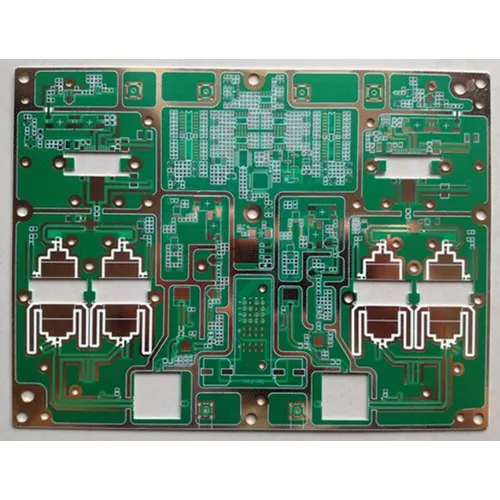
High frequency PCB (Printed Circuit Board) refers to circuit boards suitable for frequencies of 1GHz and above, mainly used in high-frequency application scenarios such as wireless communication, 5G, Wi Fi, radar systems, and high-speed data transmission. The design of high-frequency PCBs requires special attention to the frequency response speed, anti-interference ability, and signal integrity of the signal to ensure efficient transmission.
High frequency PCB are used in applications where transmission rates are critical. These types of PCBs often incorporate the use of controlled impedance designs as well as PTFE, Ceramic, or other high-speed materials. Common design features include hybrid material constructions, blind & buried vias, backdrilling, and sequential laminations. Faster communications require high speed resin systems for high bandwidth RF applications in the following industries: Military, Telecommunications (power amplifiers and antennas), RFID, DUT Chip testing, Medical and Automotive (radar).
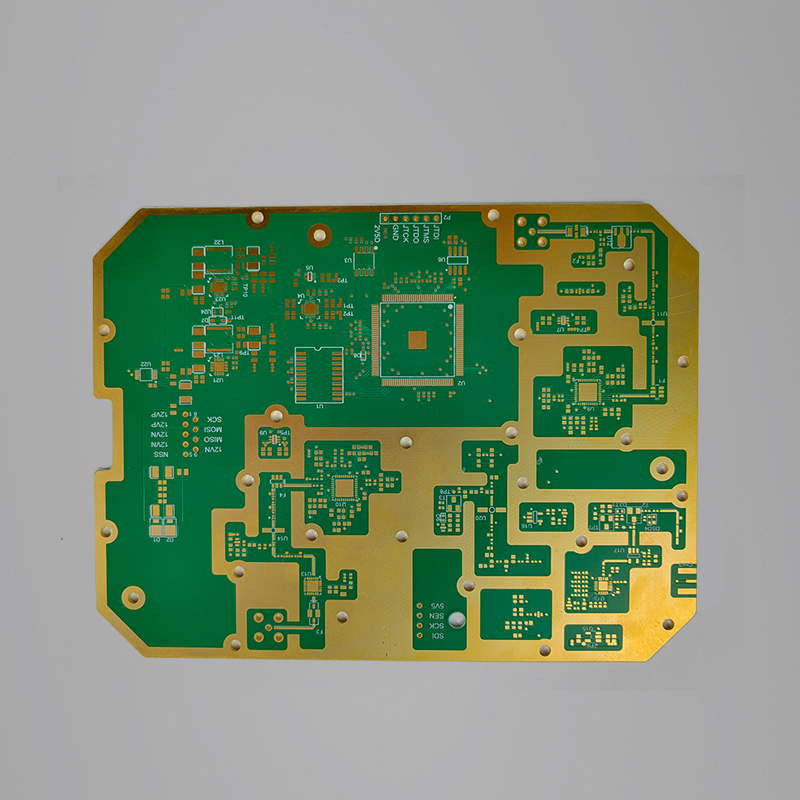
Manufacturing challenges typically surround the different types of materials required by the design. Primarily the issues include drilling, multilayer lamination, and plating activation. With our many years of experience with microwave laminate, we understand the high reliability and tight tolerance requirements of most applications. Will all the different features of every RF PCB application, we have developed partnerships with the key material suppliers such as Rogers, Arlon, Nelco, Isola, Taconic, EMC and TUC just to name a few.
Microwave & RF PCB Capabilities
Hybrid or Mixed Dielectric Boards
Wide range of material, such as: Rogers RO4350, RO4003, RO3003, RT/duroid, Arlon 85N, 33N, Nelco N4000-13, Panasonic Megtron 4, Megtron 6, TU872, EM827, TACONIC RF35, etc.
Metal Backed and Metal Core PCB’s
Cavity Boards (Mechanical and Laser Drilled)
Edge Plating
Constellations
Blind/Buried and Laser Via’s
Soft Gold and ENEPIG Plating
There is a very popular type of PCB circuit board, and that is the high frequency circuit board. high-frequency board circuit board has been favored by the market since its invention. Since the emergence of induction heating technology, it has taken the lead, and its extremely high frequency is active in the communication industry and network technology to promote a set of high-speed information processing systems. By virtue of its own advantages, it meets the requirements of many high-precision parameter instruments.

What are the advantages that make high-frequency circuit board popular?
1. Fast speed
As we all know, the transmission speed is proportional to the dielectric constant. In the electrical principle, the transmission speed is inversely proportional to the square root of the dielectric constant, that is, the larger the dielectric constant, the slower the transmission speed; the smaller the dielectric constant, the faster the transmission speed. This is also one of the reasons why the PCB high-frequency circuit board can be loved by everyone. It adopts special materials, which can well ensure the characteristics of small dielectric constant, and can ensure the transmission speed while making the operation of the high-frequency circuit board relatively stable.
2. High efficiency
Generally speaking, due to its small dielectric constant, the consumption of high-frequency circuit boards is naturally smaller than other circuit boards. Under such excellent congenital conditions, the efficiency of high-frequency circuit boards is very high. High frequency PCB can also meet the needs of target heating the induction heating technology at the forefront of scientific and technological development. Of course, while pursuing efficiency, environmental protection cannot be abandoned.
3. Great controllability
It is widely used in high-frequency circuit boards that require heating treatment of precision metal materials in various industries. In the process of its field, it can not only realize the heating of components with different depths, but also focus on heating according to local characteristics, whether it is the surface or the deep layer, centralized or decentralized heating methods can be easily completed.
4. Strong tolerance
The environment affects the composition of the medium, so high-frequency circuit boards still have some environmental requirements, especially in the places where there are more humid weather. High-frequency circuit boards can well adapt to such an environment. High-frequency circuit boards made of materials with extremely low water absorption can challenge such an environment. At the same time, it is best to make PCB high-frequency circuit boards resistant to chemical corrosion. So that it can withstand moisture and high temperature in a humid environment, and has great peel strength.
| Layer Count | 2 |
| Thickness | 0.508mm |
| Surface treatment | OSP |
| Quality standard | IPC-A-600G& IPC-6018A |
| Layer Count | 6 |
| Thickness | 1.6 |
| Surface treatment | ENIG |
| Quality standard | IPC-A-600G& IPC-6018A |

Design principles of high-frequency PCB
1. Material selection
The material selection for high-frequency PCBs is crucial, as the dielectric constant (Dk) and loss factor (Df) of the material directly affect the transmission efficiency of high-frequency signals. Materials with low dielectric constant and low loss factor can effectively reduce signal delay and attenuation, ensuring signal transmission speed and integrity. Common materials include PTFE (polytetrafluoroethylene), Rogers series plates, etc.
2. Wiring principle
High frequency signals are highly sensitive to wiring, and the number of vias should be minimized in design to avoid signal reflection and attenuation caused by parasitic capacitance and inductance effects. When wiring, the line width, line spacing, and via position should be strictly controlled, and technologies such as microstrip lines or strip lines should be used to control impedance matching and reduce reflection and distortion.
3. Electromagnetic compatibility
Good grounding design and electromagnetic shielding are key to ensuring the purity of high-frequency signals. High frequency PCBs usually adopt measures such as multi-layer grounding layers and shielding covers to isolate external interference and provide signal return paths to ensure signal quality.
The difference between high-frequency PCB and ordinary PCB:
① Application scenarios:Ordinary PCBs are widely used in various electronic devices, while high-frequency PCBs are mainly used for processing high-frequency signals, such as wireless communication, radar, etc.
② Performance requirements: High frequency PCBs require higher signal transmission speed, stability, and integrity, and special designs and materials are needed to meet these requirements.
③ Manufacturing process: The manufacturing process of high-frequency PCBs is more complex and refined, requiring high-precision equipment and processes to ensure quality.
SysPCB: an optional professional high-frequency PCB supplier
SysPCB is a PCB company with over 10 years of experience. With years of experience accumulation, we have a deep understanding of high-frequency PCBs, ensuring product quality and delivery time, making us a preferred choice for many customers. Our advantages include the following:
- High quality assurance
- No minimum order quantity
- One stop turnkey manufacturing and assembly service
- Comprehensive professional services
- On-time delivery